
Where Do Microplastics Come From Anyway?
Most people know that plastic pollution is a problem, but microplastics (the tiny fragments shed by everyday products) are much more pervasive than many realize.
Microplastics are defined as plastic particles smaller than 5 mm.
These particles are found everywhere: in oceans, soil, drinking water, food, and even the air we breathe. Yet, the origins of these particles are often invisible to consumers.
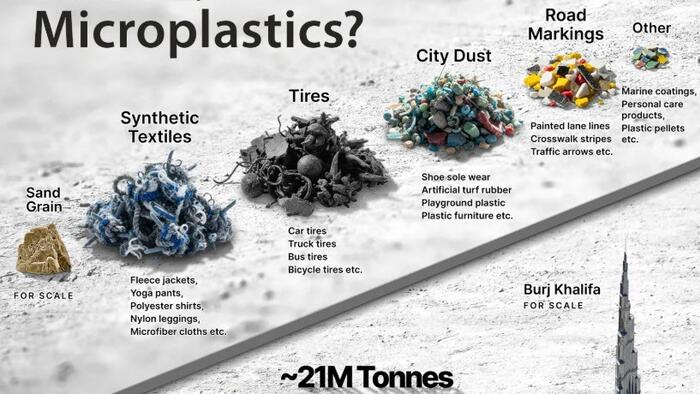
Using data from the IUCN, CSIRO, and Elsevier, this graphic, via Visual Capitalist, by Made Visual Daily breaks down what actually makes up these particles and where they come from.
A breakdown of microplastic sources, compiled from multiple environmental studies:
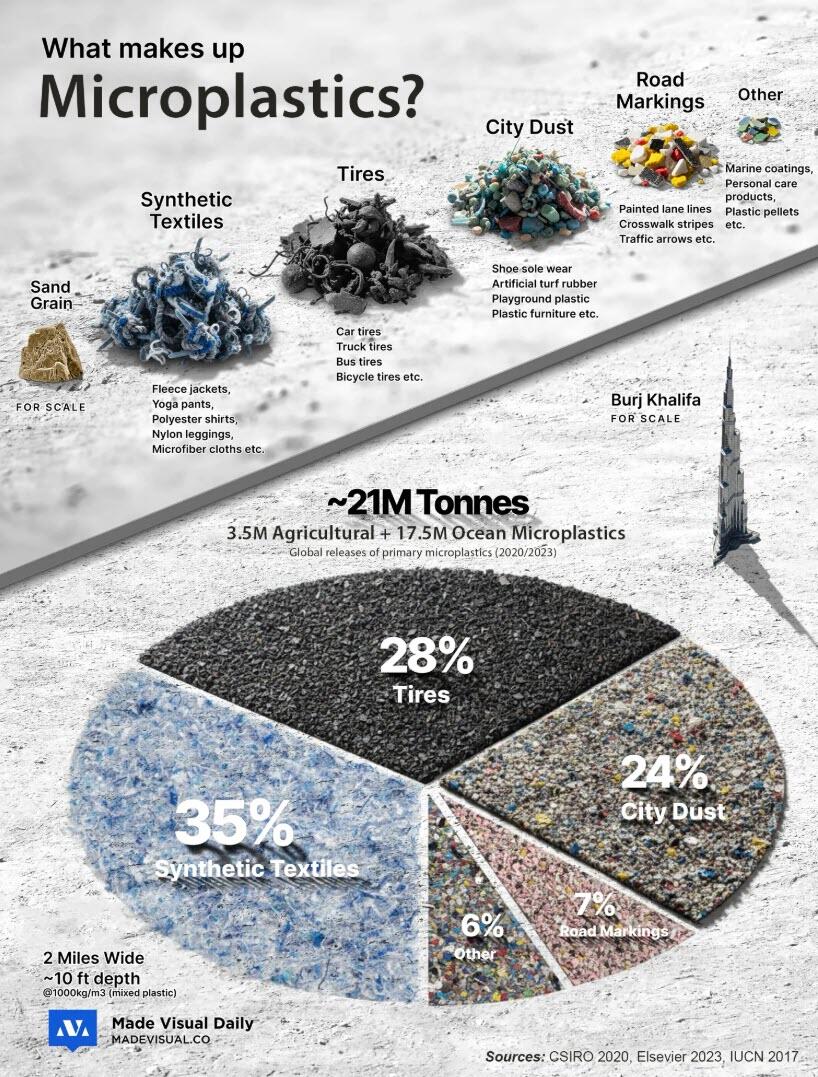
The chart shows that the biggest contributor to microplastics is synthetic textiles, which account for 35% of the total. Tires (28%) and city dust (24%) are also major culprits, followed by road markings (7%) and a grab bag of other sources (6%).
How Do These Microplastics Enter the Environment?
Microplastics enter the environment in two main forms: primary and secondary.
Primary microplastics are released directly into the environment at a microscopic size. These include:
-
Fibers shed from washing synthetic fabrics like polyester, nylon, or acrylic.
-
Rubber dust worn from car and truck tires during normal use.
-
Fragments in city dust from the abrasion of paints, soles, furniture, and building coatings.
-
Plastic pellets (“nurdles”) lost during plastic manufacturing or shipping.
Secondary microplastics, on the other hand, are formed when larger plastic debris—like bags, bottles, or fishing gear—breaks down over time due to sunlight, wave action, and weathering. These degrade into smaller and smaller pieces, eventually becoming microplastics.
Both types are persistent, pervasive, and increasingly found in even the most remote ecosystems. Research shows that even atmospheric currents can transport microplastic particles across continents and oceans.
The Scale of the Problem
Scientists estimate that roughly 21 million tonnes of primary microplastics have accumulated across land and sea environments, with millions of tonnes found in both agricultural soils and ocean waters. To help readers grasp the sheer scale of this invisible pollution, the graphic visualizes this total as an area filled 10 feet (3 meters) deep across a span of 2 miles (3.2 kilometers).
As highlighted in our previous breakdown of the future of the world’s plastic, the accumulation of these invisible pollutants is a growing concern, with long-term impacts still being uncovered.
What Can Be Done?
Solutions will require both technological and behavioral changes. For instance, innovations like microfiber filters in washing machines, and the development of alternative materials for tires and textiles, could help reduce the release of particles at the source.
In the meantime, understanding where microplastics come from is a critical first step. As this breakdown shows, the issue goes far beyond just plastic straws and bags.
Explore more microplastic visualizations like Visualizing The Size of Microplastics on Voronoi, our data storytelling app.
Tyler Durden
Tue, 12/30/2025 – 04:15