
The Trans-Caspian Pipeline Is Resurrected As Washington Plots Return To Central Asia
Authored by Conor Gallagher via NakedCapitalism.com,
If the inflation of President Trump’s ego was any indication at the C5+1 summit at the White House last week that brought together the US President with the five presidents of Central Asia, big things are coming to the region.
“You are a great leader, a statesman sent from above to restore common sense and the traditions that we all share and value,”Kazakhstan’s President Kassym-Jomart Tokayev said of Trump.
“No other president of the United States of America has ever treated Central Asia the way you do,” Uzbek leader Shavkat Mirziyoyev told Trump, adding that he was “the president of the world” and that “in Uzbekistan, we call you the president of peace.”
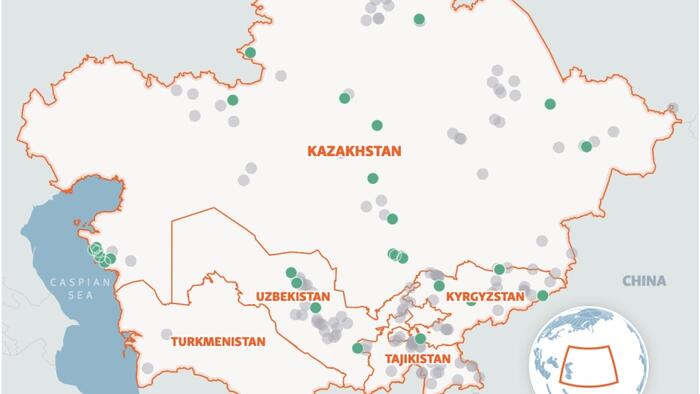
For his part, Trump called Central Asia “an extremely wealthy region.” He was referring to its natural resources, specifically rare earths in this case.
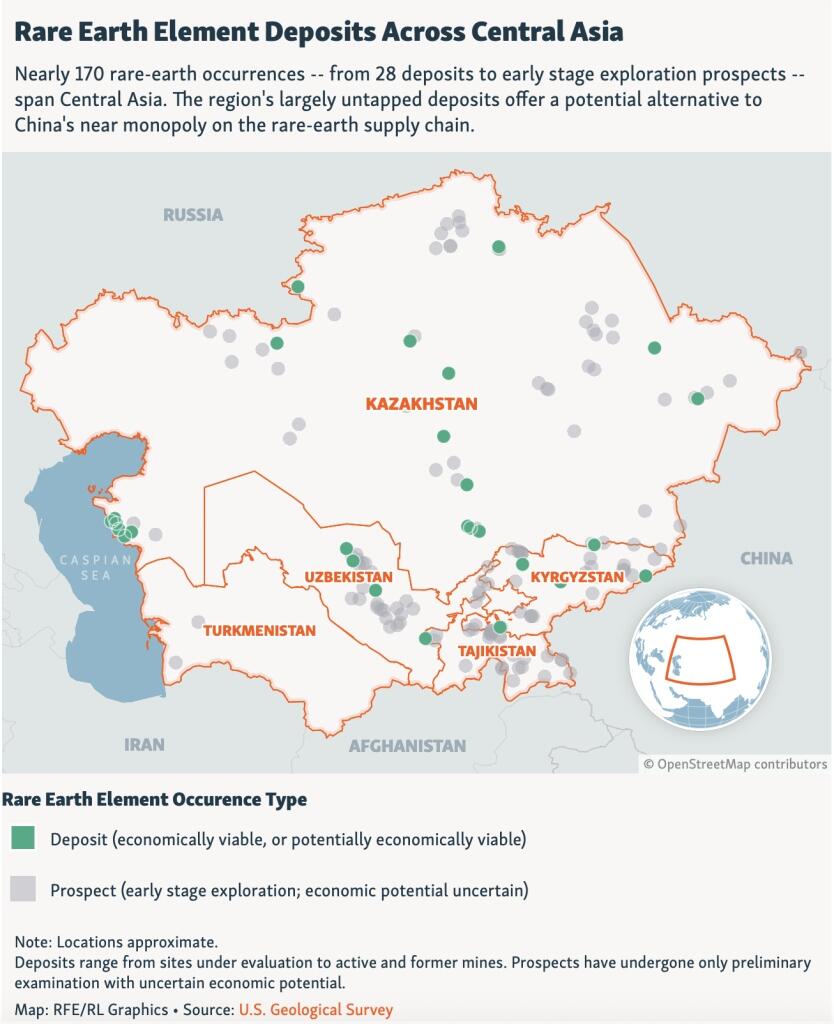
And while rare earths were largely what garnered the coverage—the meeting was more about pumping up a new US and allied push into Central Asia in order to strike a blow against Russia, China, and Iran.
The U.S. signed deals with Kazakhstan (which also joined the Abraham Accords), Uzbekistan, and Tajikistan on natural resources, Boeing planes, Starlink, and AI. The moves come at the same time that the European Union is doubling its efforts to gain more of a foothold in the region.
At the gathering Trump remarked that “Sadly, previous American presidents neglected this region completely.”
That’s not exactly true. The US has made previous attempts to become a larger player in the region.
As Ben Godwin, head of analysis at PRISM, a strategic intelligence firm in London, told RFE/RL:
“In the 2000s, it was the War on Terror and oil and gas. Then there was a decarbonisation era where many new projects in Central Asia were centred around renewable energy. Now it’s the role of critical minerals in national security.”
The problem is always staying power. Russia and China have geography on their side, as well as economic advantages and expertise in areas like rare earths. As we noted on Monday, the idea that the US is going to be competing with China on rare earth processing and refining in a year’s time is magical thinking.
While the US alone cannot compete with Moscow and no one can with Beijing in Central Asia, there are numerous players and factors involved. And as we’ve been reminded in places like Ukraine and the Caucasus, a nation’s economic self-interest is not always a guarantee of the path it will choose.
So as we’ll show below, Russia and China have the upper hand in more ways than one, but also have cause for concern—one of the biggest centers on the great ambiguity on the Bosphorous: Turkiye and its push into the region under the cover of Turkic brotherhood.
The Turkish Trojan Horse and Western Push in Central Asia
We’ve long been pointing out that despite friction between Ankara and Tel Aviv, Turkish-US-NATO cooperation was always present under the surface and picked up steam with the toppling of Assad in Syria.
Erdogan continues to cooperate with the US and Israel in Gaza.
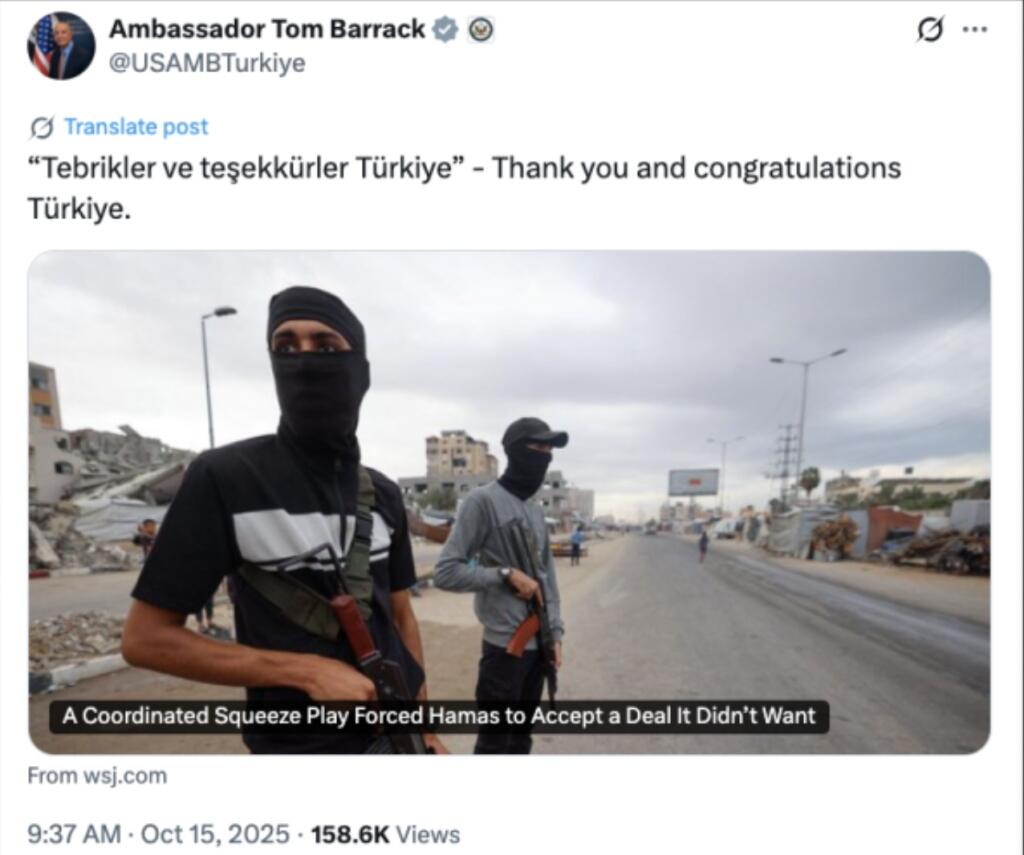
We also just discovered that former NATO chief Jens Stoltenberg and Erdogan had/have a “bromance.” Who knew?
But while so much attention on the resurgent partnership between Ankara and Washington/NATO is focused on Ukraine and the Levant, eastwards into the Caucasus and Central Asia is just as important.
The Cradle recently described Turkiye’s Gaza push as “proxy politics under US watch.” A similar dynamic is at play from Azerbaijan to Kyrgyzstan where the two sides’ interests overlap.
If there is any winner of the Trump Route of International Peace and Prosperity (TRIPP), it is Türkiye. Ankara views the corridor that cuts across southern Armenia, and for all intents and purposes links Azerbaijan and Türkiye, helping to expand its influence to the Central Asian states. And as the US and EU pour money into Central Asia in an attempt to reorient its alignment westwards Türkiye will play an outsize role. There is a problem, however.
The Islamic Republic of Iran's foreign minister has made it crystal clear today that Iran will not accept any changes to the Armenian southern border and that it will not tolerate any foreign forces there. pic.twitter.com/6HjlRYHiKB
— Seyed Mohammad Marandi (@s_m_marandi) November 6, 2025
But will Tehran intervene militarily to stop it? They may be faced with that choice before too long.
Arguably a much more consequential meeting than the C5+1 summit in Washington took place a month ago in Baku, Azerbaijan at the 12th Summit of the Organization of Turkic States.
It was there that Türkiye, Azerbaijan, Kazakhstan, Kyrgyzstan, Uzbekistan and Turkmenistan agreed to deepen cooperation across a range of areas, including trade and logistics—which would sideline Russia and increase cooperation with the EU—and defense cooperation, including joint military exercises.
And last week Baku also hosted a NATO delegation as it transitions to alliance standards and deepens cooperation with the Turkish military.
Around the same time that Türkiye was heading up the OTS meeting, the country’s lawmakers were encouraging NATO to take a heavier hand against Iran with all the usual strategies of sanctions, deterrence, and weakening Iranian “proxies” across the Levant.
A report authored by members of the main opposition party in Türkiye and presented at the NATO Parliamentary Assembly in Ljubljana alleges that Iran’s nuclear program, support for terrorism, military cooperation with Russia, and ties to China hurt Euro-Atlantic security.
While Erdogan was denouncing the genocide in Gaza, Türkiye over the past year has been steadily increasing its involvement in Western, including the launch of launch of a joint venture between Turkish drone maker Baykar (run by Erdogan’s son-in-law) and Italian defense contractor Leonardo, which has very close ties with Israel.
Of particular interest to Türkiye is expanding its access to the EU money dispenser whirring for rearmament. The two sides recently held defense talks after a three-year pause. At the end of October Türkiye and the UK signed a multibillion-dollar deal for the sale of 20 new EF-2000 Eurofighter Typhoon jets, which is a big deal for Türkiye as it looks to get its indigenous fighter jet program off the ground.
Türkiye certainly has agency, and Erdogan’s ruling elite have ambitions to resurrect the country as a world power, but for now both Iran and Russia view Ankara’s eastward moves as a trojan horse for the US, UK, and NATO. For now at least, it is a marriage of convenience. As Ali Nassar writes at The Cradle:
It reveals a layered geopolitical project anchored in Pan-Turanist nationalism, Muslim Brotherhood-aligned political Islam, and strategic deployment of military and development tools – crafted to serve Ankara’s national interests while converging with NATO’s broader regional goals.
…Pan-Turanism, an early 20th-century ideology premised on the unification of Turkic-speaking peoples from Anatolia to western China, has been resurrected in Ankara as a vehicle for geopolitical consolidation. Today, Turkiye deploys this vision to deepen its grip on Central Asia – particularly in Kazakhstan, Uzbekistan, Turkmenistan, Kyrgyzstan, and Azerbaijan.
This ideological push is operationalized through the Organization of Turkic states, which functions as a joint political, economic, and security bloc linking Ankara with these post-Soviet republics.
Türkiye and the West also have visions of using the TRIPP as an energy corridor to send fossil fuels and other resources from Central Asia and the Caspian westwards while cutting out Russia and Iran, all the while increasing their footprint in these countries, effectively carving out a chunk of the Eurasian “heartland.”
Resurrecting the (Idea of the) Trans-Caspian Pipeline—or a Tanker Fleet
Notably, Türkiye and Turkmenistan recently halted gas exports via Iran following the reverberations from the decision by Washington to block Iraq from importing gas from Turkmenistan via a swap deal with Iran. Now the Trans-Caspian Gas Pipeline—or transport via tankers— is back on the radar after years of technical, legal, and political obstacles. From Eurasianet:
The possible ramifications of the US [Iraq] block appear to have been understood by Ashgabat. Speaking at the 5th Tbilisi Silk Road Forum on October 22, Turkmen Foreign Minister Rashid Meredov confirmed that Ashgabat is committed to reviving the “Silk Road” concept of transiting gas from Central Asia to Europe.
“Turkmenistan has always emphasized the great importance of the Western direction, specifically the creation of a stable energy corridor along the Caspian Sea-South Caucasus-European route,” he said.
There are signs too that Azerbaijan, through which any Turkmen gas exports to Türkiye and Europe would have to transit, is open to the idea.
Baku’s strategy has always been to prioritize the development and export of gas from its own reserves. However, efforts to boost gas output from its giant Shah Deniz gas field and Azeri-Chirag-Guneshli oil field have yet to bear fruit. Azerbaijani officials accordingly have confirmed they will be unable to double gas exports to Europe to 20 bcm per year as promised to the European Union.
One reason Azerbaijan isn’t going to be able to fulfill that demand is because Russia is no longer laundering as much gas through Azerbaijan to the EU due to Western-supported friction between Baku and Moscow.
Back to the grand plan to replace it:
Additional volumes of Turkmen gas, then, could help Baku ultimately meet its delivery commitments.
If all sides are on board with a trans-Caspian pipeline, investors would be more likely to consider financing for construction, as well as the necessary expansion of capacity of existing lines through Azerbaijan, Georgia and Türkiye to Europe. Gas could also potentially transit via a pipeline built along the envisioned Armenian-Azerbaijani land corridor, dubbed the Trump Route for International Peace and Prosperity.
And so here we start to see the grand design come together. It would be a strange economic decision, but those seem en vogue these days.
A Trans-Caspian route would also upend Kazakhstan operations by Western majors like Chevron, ExxonMobil, and Shell, which already play major roles in Kazakh oil; the problem apparently is that more than 80 percent of it moves through the Caspian Pipeline Consortium (CPC), which delivers crude via pipeline through Russia to the Black Sea port of Novorossiysk. The pipeline has continued operating through three years of war and it by all accounts a good deal for all involved.
But Nurul Rakhimbekov, the Founder and President of the DC-based think tank Center for Global Civic and Political Strategies, writes that it’s not safe. As evidence, he cites the fact that in February and October of 2025, drone strikes on the pipeline infrastructure threatened supplies.
Who was behind the strikes? NATO-backed Ukraine, of course.
Supporters of the Trans-Caspian route envision it linking up with a new pipeline through TRIPP or the existing Baku–Tbilisi–Ceyhan (BTC) pipeline that runs from Azerbaijan to Türkiye via Georgia and then onto Europe. Rakhimbekov writes:
The BTC route offers a secure, Russia-free pathway from the Caspian to the Mediterranean, connecting Kazakhstan’s oil to markets in Europe and Israel via Türkiye’s port of Ceyhan. It also dovetails neatly with Western efforts to reduce dependence on Russian energy corridors.
Unlike the congested Black Sea route, BTC provides stable access to global markets and reduces insurance and logistics costs that have been driven up by regional instability. Technically, a trans-Caspian connection — whether through a growing tanker fleet or a future subsea pipeline — could handle 50 to 60 million tons per year, matching the CPC’s capacity and giving Kazakhstan more control over its own export future.
The diplomatic groundwork for this shift is already in place. Washington and its allies have expressed broad support for Kazakhstan’s diversification strategy. The next step is execution.