

Taibbi: Is Russia At War With Ukraine, Or With The West?
Authored by Matt Taibbi & Racket Staff via Racket News,
German Foreign Minister Annalena Baerbock this week, on entering a “new era of nefariousness”:
I say clearly and across the Atlantic, what is right and what is wrong shall never be irrelevant to us. No one wants and no one needs peace more than the Ukrainians and Ukraine. The diplomatic efforts of the U.S. are of course important here. But such a peace must be just and lasting and not just a pause until the next attack… We will never accept a perpetrator-victim reversal. A perpetrator-victim reversal would be… the end of security for the vast majority of countries. And it would be fatal for the future of the United States.
Baerbock’s declaration that a “perpetrator-victim reversal” (a Täteropferumkehr, I’m reliably informed) would be “fatal” to the U.S. was historic. It was accompanied by a promise that “as transatlantacists,” Europeans must “stand up for our own interests, our own values, and our own security.” Although new leaders are ready to take the reins in Germany, she said, there can be no waiting for the transfer of power. Immediately, “Germany must take the lead at this historic milestone.”
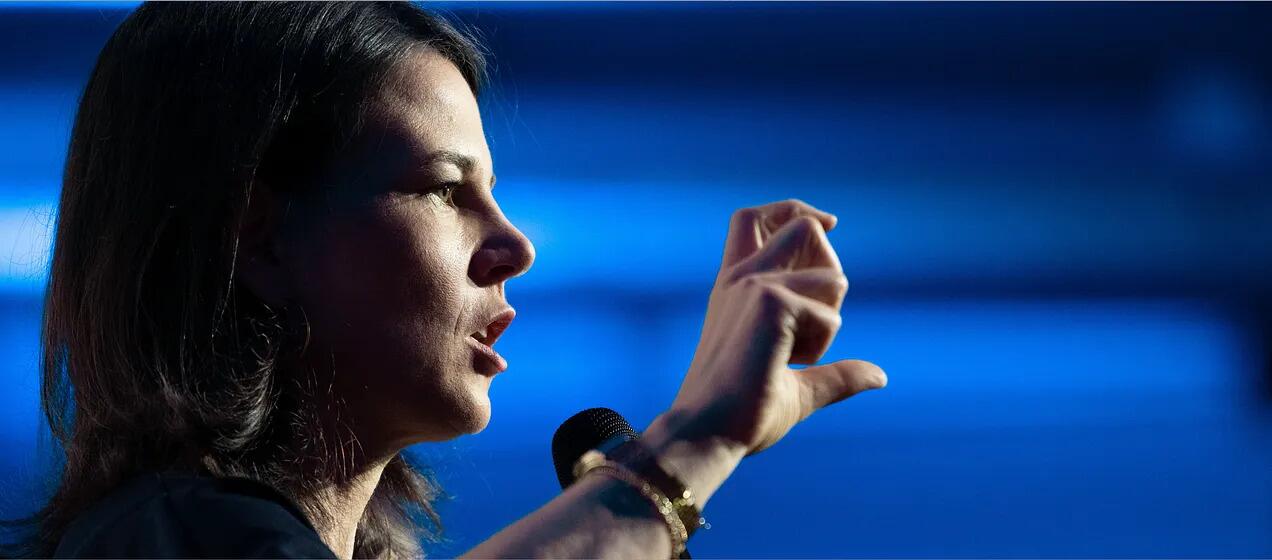
A few years ago Baerbock pleaded for patience with a British conservative who demanded to know why Germany wasn’t providing Leopard tanks to Ukraine.
Now, with Donald Trump cutting off weapons deliveries and shutting down access to ATACMS missiles, Baerbock’s speech is an expression of more enthusiastic European support for continued fighting.
The war in Ukraine is often called a proxy conflict between Russia and the West or Russia and the U.S., but it increasingly looks more like a fight between Baerbock’s “transatlanticists” and those who believe in “spheres of influence.” In preparing Racket’s accompanying “Timeline: The War in Ukraine,” I found both sides articulated this idea repeatedly.
In January, 2017, as he was preparing to relinquish his seat to Mike Pence, Joe Biden alluded to the recent election of Donald Trump in a speech at Davos. Describing the “dangerous willingness to revert to political small-mindedness” of “popular movements on both the left and right,” Biden explained:
We hear these voices in the West—but the greatest threats on this front spring from the distinct illiberalism of external actors who equate their success with a fracturing of the liberal international order. We see this in Asia and the Middle East… But I will not mince words. This movement is principally led by Russia.
Biden even then lumped Trump and Putin together, as enemies of the “liberal international order.” Russian counterparts like Putin and Foreign Minister Sergei Lavrov, meanwhile, spoke of a “post-West world order” where diplomatic relations would be based on “sovereignty” and the “national interests of partners.” These are two fundamentally irreconcilable worldviews. Was conflict inevitable, or could peace have held if Russia didn’t strike in 2022?
There’s no question who invaded whom. Hostilities began in February, 2022 with an angry speech by Vladimir Putin and bombs that landed minutes later in Ukraine. Little discussion of the “why” of the war took place in the West, however.
Phrases like “unprovoked aggression” became almost mandatory in Western coverage. Politico interviewed a range of experts and concluded that what Putin wanted was “a revanchist imperialist remaking of the globe to take control of the entire former Soviet space.” This diagnosis of Putin’s invasion as part of a Hitlerian quest for Lebensraum and a broader return to national glory might have merit, but it was also conspicuously uncontested. A differing article by University of Chicago professor John Mearshimer declaring the crisis “the West’s fault” made him, as The New Statesman just put it, “the world’s most hated thinker.” Few went there after.
Russians and Ukrainians don’t have the typical profiles of ancient warring tribes. They have a deeply intertwined history, with citizens of both countries retaining many of the same customs, jokes, and home remedies, while living in the same crumbling Soviet buildings, with fondness for the same cabbage soup and moonshine. There are huge numbers of mixed/bilingual families and many famous cultural figures (including my hero Nikolai Gogol) are claimed by both countries. They’ve fought before, but what jumped out reviewing this “Timeline” is how much it seemed that these old Slavic neighbors mostly fall out now over attitudes toward the West.
It’s hard looking back not to be struck by the superior tone of bodies like the Organization for Security and Co-operation in Europe (OSCE), whose “reviews” of Ukrainian and Russian elections often read like zoological descriptions of inferior species. Same with a tsk-tsking report by a mission of visiting IMF economists in 2013, who were appalled by Ukrainian energy subsidies that were among of the few popular remnants of Soviet life.
These imperious Western assessments of childlike Slavs, and the panic and shame of some local officials before such foreign judgments, recall familiar satires in Russian literature (The Government Inspector comes to mind). Nationalists in both countries balked at this “advice,” and by the late nineties some came to the conclusion that the cost of cooperation with the West was greater than the benefit. These dynamics accelerated after the Orange Revolution in 2004 and the Maidan events of 2013-2014, which Russians still see as a West-backed coup and the beginning of the current war. Russians will say “first blood” was drawn in military operations against Donbass protesters around the same time. Those in the West will point at the 2014 annexation of Crimea as the beginning of territorial war.
The idea of Germany “taking the lead” in a war to secure the primacy of “transatlanticists” worries me more than trying to pronounce Täteropferumkehr. However, whether or not you think Baerbock is right, and a peace deal now would be a worthless “pause,” depends a lot on how you read this history. What do you think, and why?
Tyler Durden
Mon, 03/10/2025 – 19:30