
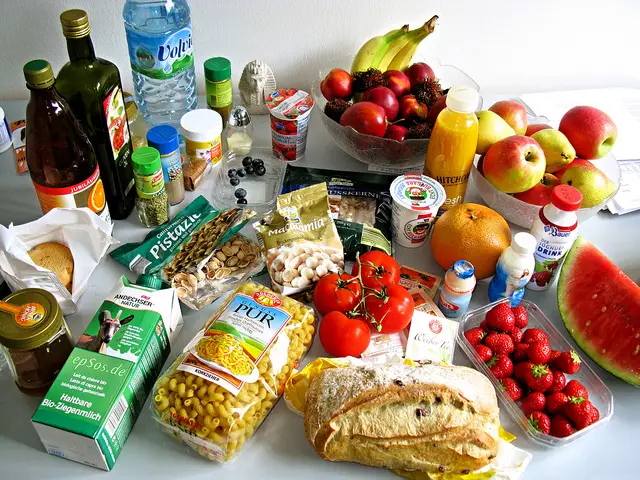
I spent my teenage years working in a supermarket, initially as a box boy. Within six months of being hired, however, I was promoted to checker. Eventually, I got to work almost every job in the store including working the deli counter, and helping the overnight stock crew fill shelves and reprice products after the store closed.
Anyway… I continued to work at the store for three years, until I left home to attend college up the coast.
Lessons Learned
To be sure, I learned some valuable lessons while working at the supermarket. Although it’s not true any more, the first thing I learned was that grocery store checkers were paid very very well at the time. Although I had not reached the top pay level by the time I quit, I was still earning the inflation-adjusted equivalent of roughly $45 per hour — and $135 per hour on holidays. Meanwhile, the most senior everyday checkers were pulling down about $50 per hour (and $150 per hour on holidays).
That’s not too shabby for a teenager with few financial obligations.
Even so, working in a grocery store was not a very fun way to make a living. Not only is working as a grocer back-breaking work, but you also have to deal with the public on a daily basis — which in my case meant I even had to endure an armed robbery while working there.
It wasn’t all bad though. Working there did help me earn and save enough money to pay for my college education.
Perhaps even more importantly, I also learned a few tricks that many supermarkets still use today to get a little extra money out of their customers and pad tight profit margins.
Here are some of the most deceptive price tricks to watch out for at your local grocery store:
End cap “specials” that are anything but
The items you see at the end of each grocery aisle – known as the “end caps” – are not typically the areas where you’ll get great deals. In fact, the end caps are often misleadingly used to push items that aren’t on sale. Oh sure, grocers will make the end caps look festive and boldly advertise the price as if it were a good deal, but it’s usually not. In fact, end cap items often provide grocery stores with some of their biggest profits.
Bad deals at the checkout line
Just like the items on the end caps, you need to avoid the candy, gum and magazines you’ll find at the checkout line. These items are almost always high profit-margin products that can really run up your bill.
Name-brand products placed on shelves at eye level
Why do stores do this? Because the premium you pay for name brand products can be as much as 50% and sometimes even more – even though store brands are often of similar quality. If you want to save money you’ll usually need to look down low for those store brands.
Sale prices on only selected product varieties
It’s true; many times a store will advertise a sale on a product, but if you don’t read the fine print or look closely at the price tags – you might not realize that the sale is only on certain varieties. At our store we used to do this with Spaghetti-Os all the time. We’d put the plain Spaghetti-Os on sale – but the shoppers buying the variety with franks or meatballs paid the full price.
Deceptive price tags
When you see a price tag that says “5 for $5.00” it doesn’t necessarily mean you need to buy five items to get the deal. In fact, more often than not you can usually get away with buying just one for a buck. As a box boy working the late night shifts I’d occasionally mark down stuff in the bargain bin with ridiculous prices like “7 for $1.89” or “3 for $2.37.” Just for fun. The best part was when a happy customer would bring the marked-down item to the check stand and I got to watch the poor checker try to figure out the unit price in his head. Of course, the checker would look at me and I’d just shrug my shoulders and give a sheepish grin.
Looking back, it’s a wonder I ever got promoted.
Photo Credit: Boris Anthony
The post Sneaky Price Tricks Your Grocer Doesn’t Want You to Know appeared first on Len Penzo dot Com.