
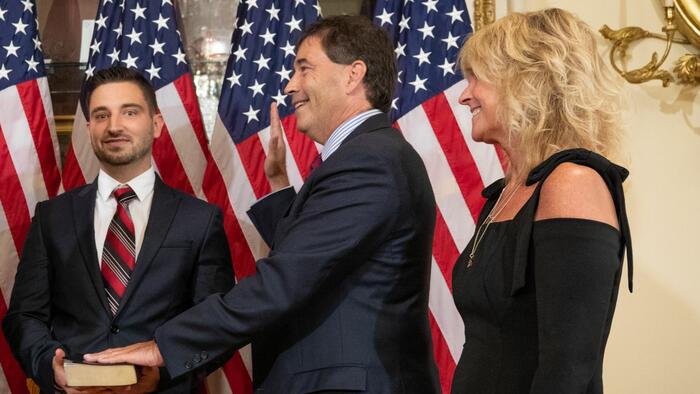
Rep. Troy Balderson Is Right: Coal And Gas Drive Affordable, Reliable, And Clean Energy
Authored by Jude Clemente via RealClearEnergy,
The International Energy Agency (IEA) defines energy security as “The uninterrupted availability of energy sources at an affordable price.” In that context, no other energy sources in the world can stand against the combination of American coal and natural gas. And coming soon, utilities expect Small Modular Reactors starting as soon as 2030.

Congressman Troy Balderson (R-OH) recently introduced “The Affordable, Reliable, Clean Energy Security Act” to ensure U.S. energy dominance and protect baseload generation with coal, natural gas, and nuclear. His ARC bill guarantees America’s most important dispatchable electricity sources remain central to the mix – a requirement to provide affordable and reliable energy for American families and businesses, all becoming more essential as the AI and data center build-out is set to explode, in a world where China is deploying domestic, low-cost coal to accomplish the exact same national security imperative. No wonder why President Trump is prioritizing dispatchable power: the data centers driving our digital economy demand constant flows of electricity, namely without interruption to prevent data loss, service disruption, and equipment damage.
Baseload power plants serve on an around-the-clock basis, producing electricity at a consistent rate and thereby maximizing efficiency and minimizing costs. Coal and natural gas are classic baseload fuels characterized by abundance, availability, accessibility and established production, distribution and utilization systems. For example, dispatchable generation from coal and gas can be adjusted by system operators to match supply with electricity needs. Wind and solar, on the other hand, as defined by Rep. Balderson, have “intermittent availability” and are weather dependent sources whose production is contigent on the availability of the resource – the wind and the sun. The physical reality is that the U.S. Department of Energy has long defined wind and solar as, naturally, “non-dispatchable.” Moreover, there is solid evidence that once these renewables reach a certain proportion of the grid, reliability is at risk – e.g. the April 2025 widespread power outages in Spain and Portugal.
In an electricity system, “capacity value” refers to the estimated contribution of an energy resource to the system's ability to meet peak demand and maintain reliability. Essentially, can installed capacity be counted on during times of peak demand? How much of a plant’s capacity is available when the system needs it most? Rolling and Orr have demonstrated how system planners recognize the capacity value limitations of wind and solar. As our largest power market serving 65 million Americans, PJM Planners, for example, assign an expected capacity value to coal at 80% and gas at about 75% through 2035. In sharp contrast, PJM sees the value of onshore wind declining from 41% in 2027 to only 19% in 2035 and solar never even reaching 10% in the next decade.
What this ultimately means is that wind and solar are more often “unavailable” than “available” to deploy and thus simply not possible to be the foundation for a PJM forecasting that from 2025 to 2045 winter peak power demand will soar by nearly 65%, with summer peak rising 50%. Our “greenest” state is California, having done all that it can to “get off fossil fuels” with renewables for decades, yet gas still generated nearly 60% of the state’s power on some days in September. Clearly more “supplemental” than “alternative,” PJM explains the intermittency problem and limited outlook for renewables:
“The ratings for the two wind classes decrease significantly due to… winter historical performance patterns” … The ratings for the two solar classes remain stable at low values during the entire period.”
Serving 45 million Americans, MISO is the electric grid operator for the central U.S., ensuring power flows reliably and affordably across 15 states and Manitoba. MISO system planners present a similar warning relating to the capacity value of wind and solar vis-a vis coal and natural gas: “dispatchable thermal resources, such as natural gas and coal, are forecast to provide a much larger fraction of the region’s total needed accredited capacity compared to wind and solar, which have significantly lower accreditation values due to their weather dependent nature.”
Consider, for example, the 2025 Polar Vortex which pushed the U.S. power grid to unprecedented levels of demand. In response, grid operators relied heavily on dispatchable generation from coal and natural gas to ensure system reliability and stabilize supply. Wind and solar were challenged due to “unfavorable weather conditions.” On the peak day, wind and solar were only able to generate 3% and 0.2% of the incremental electricity needed. In contrast, coal and gas provided 66% of electricity during the Vortex. With climate change making our weather even less predictable, heavy reliance on weather dependent resources pose obvious problems. We continue to see the really bad consequences of retiring too much coal, too quickly, all as our power needs are starting to rise again. Experts at Power the Future warn of “a looming electricity affordability crisis,” and it is exactly why Rep. Balderson has also called for “Restoring American Coal Dominance.”
In terms of affordability, Rolling and Orr analyzed the cost of power from existing thermal power plants in the MISO region and found the cost of coal per Megawatt Hour as $37.45 and natural gas as $38.14. In comparison, the cost of New Wind is $46.30 and solar is $71.21. They note that these numbers should hardly be surprising. The existing coal and gas plants are more affordable because they have already paid off most of their initial capital costs, and utilities no longer earn much in the way of a rate of return on these depreciated assets. Thus, existing coal and gas plants are typically the most reliable and least expensive plants in the power system.
Troy Balderson has proposed legislation which would provide American consumers with the affordable and reliable energy necessary for the nation to meet its electrification aspirations – especially in regard to data centers. As a reminder, electrification (i.e., much more electricity demand) itself is cited by green groups as critical to reducing emissions and fighting climate change. Flat really since 2008, annual U.S. electricity needs are set to rise by more than 50% over the next decade, to well over 6,000 terrawatt hours. While wind and solar surely offer good value in certain locations and at certain times, our required backbone for booming power needs remains obvious: dispatchable power from coal and gas provides consistent energy supply, supports grid stability, and enhances energy security.
Jude Clemente is the Editor at RealClearEnergy.
Tyler Durden
Fri, 10/31/2025 – 20:05