
Regenerative Agriculture Finally Has A Seat At The Table At USDA
Authored by Ryland Engelhart via The Epoch Times (emphasis ours),
Commentary
Something unusual and long overdue recently took place at the U.S. Department of Agriculture (USDA).

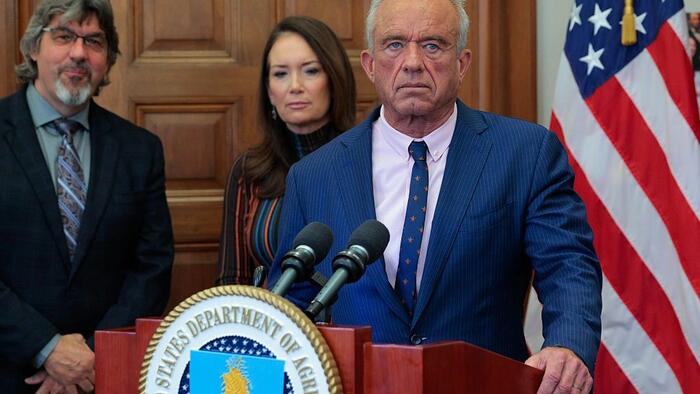
Two regenerative agriculture pioneers, Rick Clark of Indiana and Blake Alexander of California, stood alongside Health Secretary Robert F. Kennedy Jr. and USDA Secretary Brooke Rollins as the department announced a new $700 million investment in regenerative agriculture.
Given recent history, skepticism is understandable. Cuts to farm-to-school lunch programs, the rollback of farmer grants funded under the Inflation Reduction Act, and a longstanding lack of consistent support for small and mid-sized family farms have left many producers wary of federal promises. I understand the doubt. Many farmers have learned, the hard way, to expect little.
Still, this moment matters.
As someone who followed RFK Jr. to the White House, I have remained clear-eyed about the limits of his authority at the Department of Health and Human Services (HHS). Agriculture policy does not sit within HHS, and his portfolio is already full. Yet Kennedy has long understood the opportunity that regenerative agriculture presents, not just for farmers but also for public health, environmental resilience, and food quality.
That understanding helped inspire Kelly Ryerson, Rick Clark, and me to co-found American Regeneration, an organization created to educate, inform, and influence this administration, particularly within the MAHA ecosystem, on why soil health must be part of the national agenda.
Over the past year, our team and advisers made eight trips to Washington, meeting with policymakers, submitting memos, and engaging in sustained dialogue. Across those conversations, one conclusion became unavoidable. If policymakers want conventional producers to transition toward regenerative practices, they must fund the transition and tie that funding to measurable outcomes.
For me, seeing this announcement felt like a long-held vision beginning to take shape.
I was traveling home from the 50th anniversary of the Acres Conference in Madison, Wisconsin, where my sister, Mollie Engelhart, shared the main stage with regenerative leaders such as Will Harris and Joel Salatin. We screened an educational cut of Common Ground for more than 600 farmers and hosted a Q&A with regenerative pioneers Gabe Brown and Rick Clark. From there, I headed south to the Mycelia food systems conference in Sebastian, Florida.
During an Uber ride, I received a message from Calley Means, a White House adviser to Secretary Kennedy and a leader within the MAHA movement. “Check your email,” she wrote.
Inside was a preview of a regenerative agriculture framework scheduled for release in the coming weeks.
Over the last year, Means and I have exchanged ideas on how USDA and HHS could work together to encourage soil-health adoption among conventional growers. Those discussions, across meetings, memos, and policy proposals, kept circling back to a principle long championed by Gabe Brown. Incentives only work when they reward real results.
That principle is embedded in this new USDA pilot, and it marks a clear departure from past conservation programs.
Among its distinguishing features:
- It explicitly uses the term “Regenerative Agriculture.”
- It relies on a single, streamlined application rather than fragmented enrollment.
- It allows bundled conservation practices under a whole-farm plan.
- It supports multi-year transitions, not short-term experiments.
- It establishes baseline soil testing.
- It reflects cross-agency coordination beyond a siloed conservation effort.
- Continued funding is tied to demonstrated improvements.
The pilot reflects a growing recognition that regenerative agriculture sits at the intersection of farm economics, environmental stewardship, and public health. By helping cover the financial risk of transition, the program offers producers a way off the conventional input treadmill and toward systems that rebuild soil biology and long-term profitability.
This is a shift from paying farmers to comply with practices to paying them for outcomes. Those outcomes include better food, cleaner water, healthier soil and air, and ultimately healthier people.
Over the past year, I have also had the opportunity to get to know Jimmy Emmons, an assistant chief at the Natural Resources Conservation Service (NRCS) and a regenerative producer himself. He played a key role in shaping this program. His work, alongside input from leaders across the regenerative agriculture landscape, reflects a serious effort to align policy with on-the-ground realities.
From my vantage point, this represents a meaningful cultural shift. For the first time at this level, senior leaders across USDA and NRCS are openly engaging with soil health as a pathway to farmer profitability and nutrient-dense food. I have witnessed growing curiosity and seriousness within federal agencies about regenerative agriculture. That alone is significant.
Rick Clark’s role underscores that shift. A founding member of American Regeneration, Clark farms 7,000 acres in Indiana using a no-till regenerative system that has reduced his input costs by nearly $2 million annually. Today, he is being asked to show up in Washington to help guide policy.
As Clark put it: “This is historic. The program is well thought out. It is farmer-based and outcomes-based. It is a victory for regeneration.”
So too are the words and presence of Blake Alexander, a California pioneer whose regenerative-certified dairy is now among the most recognized in the country. At the announcement, Alexander described regenerative farming as simply farming in harmony with nature, paying attention to biology and building nutrient density in soil, plants, and animals.
Seeing producers like Clark and Alexander standing at the USDA, leaders who are improving soil health while strengthening farm economics, signals a clear direction for where federal agricultural policy may be headed.
The USDA has now committed significant resources to regenerative agriculture. While $700 million is modest relative to the number of farmers and acres nationwide, this effort is explicitly designed as a pilot. If outcomes are demonstrated, the funding could expand. More importantly, the conversation has changed. Farmers who deliver real, measurable improvements may finally be rewarded for doing so.
Government bureaucracy often struggles to implement new systems, and skepticism remains warranted. I understand that. But progress also requires acknowledging meaningful steps when they occur.
For my world, and for the future of American farming, this moment is worth recognizing.
Let’s regenerate.
Views expressed in this article are opinions of the author and do not necessarily reflect the views of The Epoch Times or ZeroHedge.
Tyler Durden
Mon, 12/29/2025 – 20:55