
New Generation Of Industries Emerges In Texas As Rare Earths Race Ignites
Authored by Dylan Baddour via Inside Climate News (emphasis ours),
Major oil companies are drilling in East Texas again, but not for oil. This time, they're after lithium for batteries and other rare elements.
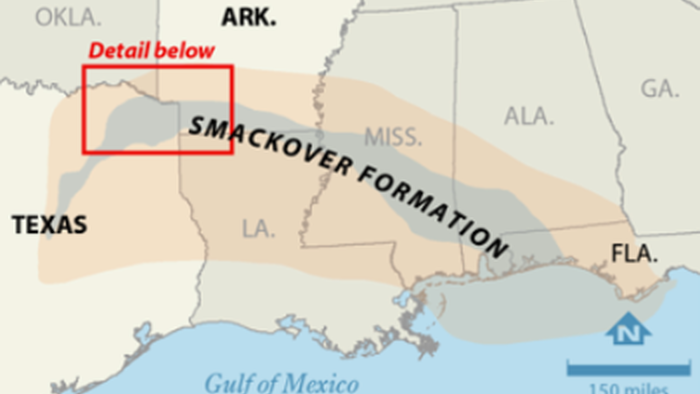
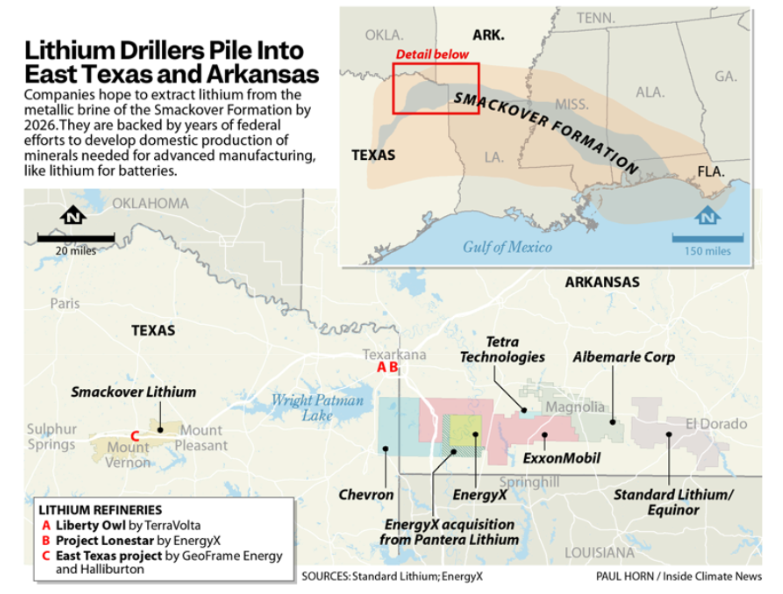
Chevron and Halliburton announced East Texas projects this summer. Exxon has acreage across the border in Arkansas. Smackover Lithium, a joint venture of a Norwegian oil giant and a Canadian miner, announced in late September the discovery of the most lithium-rich fluids ever reported in North America, measured deep beneath its Texas claims in a massive brine deposit called the Smackover Formation.
"It's ripe for development," said Jamie Liang, a former Wall Street banker and founder of Houston-based lithium startup TerraVolta, which is developing a lithium refinery on the Smackover with federal support. "There's tremendous growth potential."
Lithium mining is one of several mineral industries emerging in Texas as part of broad federal efforts to urgently establish American production of the materials required for advanced manufacturing, from batteries and solar cells to wind turbines, microchips and cruise missiles.
Competition with China looms over this effort. For much of this year, the world's two largest economies have been locked in trade tensions— and much of the ire is linked to minerals used in technology. This month, China announced new export controls on critical mineral products, including lithium battery components. President Trump, in social media posts, described China as "very hostile" and threatened to impose export controls on critical software and add 100 percent tariffs to Chinese imports.
Near Texarkana, the chase for lithium is backed with robust federal support. Liang's TerraVolta received $225 million from the U.S. Department of Energy in 2024 for its lithium refinery complex. This year the project was selected for fast-tracked permit review.
It will pump up the naturally metallic super-salty fluids from the Smackover, extract lithium and other minerals and then inject the leftover liquids back underground. At least two other lithium refineries are planned in the area and companies have leased tens of thousands of acres for drilling. More will likely follow as long as lithium prices stay strong.
"There's going to be a very large-scale infrastructure buildout," Liang said. "You're going to be drilling wells. You're going to need those service companies. You'll need pipelines."
Elsewhere in Texas, a mine is planned near El Paso for the rare metals used in magnets for electric motors. On the rural Gulf Coast, the Department of Defense has invested almost $300 million in a project that would process rare metals like samarium, used in jet engines, guided munitions and stealth technology. From Houston's petrochemical complex to the Permian Basin, a flurry of startups, oil majors and mining giants intend to recover minerals from industrial waste like coal ash, discarded electronics, mine tailings and oilfield wastewater in hopes of accelerating U.S. mineral supplies.
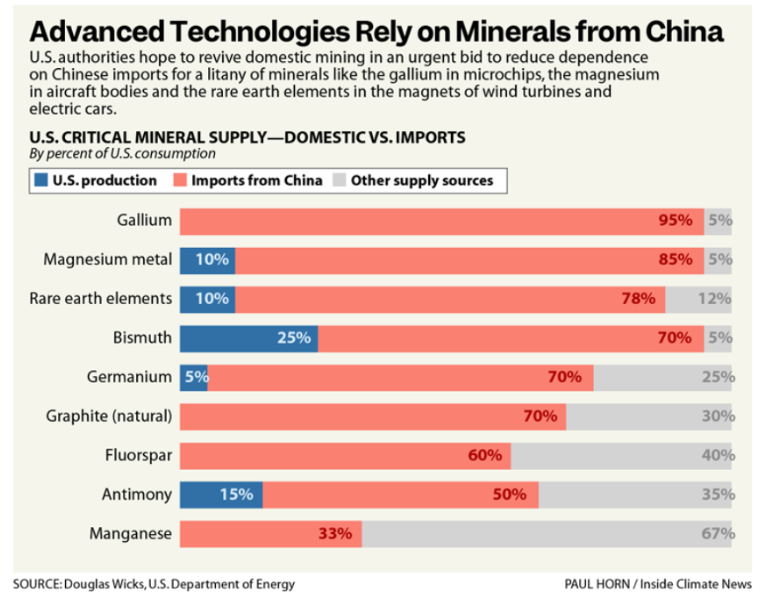
Presently, the United States produces a dribble of the raw materials. China broadly owns the global production lines, following decades of investment and securing a dominance that has raised national security concerns as well as financial risk.
The United States has just one operating lithium mine, in Nevada, where a second mine with government backing expects to begin production in 2027. Only one lithium refinery operates in the country, on the Gulf Coast of Texas.
"Our exposure to China is unacceptable," said Douglas Wicks, a former program director at the Advanced Research Projects Agency of the Energy Department. It raises threats that the outbreak of conflict could leave the United States cut off from essential supply chains.
That's the biggest reason why federal agencies are pushing so hard to play catch-up and boost American mining, Wicks said. As geopolitical tensions squeeze the flow of globalized commerce, Washington hopes to challenge Beijing's monopolies in a battle of extraction.
"I think American industry can outproduce them," said Wicks, who retired this year. The United States has "the deposits to do this."
However, the United States has to contend with China's gargantuan economy where the state owns key industries and provides subsidies, preferential finance schemes and other market support. Still, Wicks said, the United States knows how to move quickly. Just consider the recent evolution of American oil and gas. Technical innovations and loosened environmental standards in the shale revolution turned the United States from the world's largest importers of oil and gas to a major exporter in barely over a decade. Wicks believes the United States can transform again.
In 2023, under the Biden administration, the Pentagon was ordered to establish mineral supply chains independent of China. Since then, billions of dollars have flowed to mining and processing projects across the country, spurring a rush of prospectors and entrepreneurs hoping to cash in on federal grants.
Wisk said, "Now there's a big push in Texas to ask: 'Is there something else under the ground other than oil and gas?"
Tiny Concentrations, Big Mines
In the desert of far-west Texas, a company called Texas Mineral Resources Corp. (TMRC) had plans to dig for rare earth elements at a 950-acre Round Top Mountain site. The company won its first Defense Department contract in 2015. In January it reported a "breakthrough," producing a sample of high-purity dysprosium, which is used in semiconductors and electric vehicle motors. .
These rare elements aren't actually hard to find. They're all over the world, but they exist in tiny concentrations that require a tremendous amount of effort to extract in significant volumes. The process also generates large waste streams.
TMRC had said it would crush up 20,000 tons of rock a day. The material then would soak for a month in pools of diluted acid and undergo a series of electromagnetic processes to separate and cull the much-desired minerals. According to TMRC, the rocks hold 15 rare earth elements and other metals including lithium, gallium, hafnium, zirconium and beryllium.
Some processed byproducts "are expected to show hazardous waste characteristics," and "the waste may contain naturally occurring radioactive material," according to a 2019 economic assessment by TMRC. It noted "potential impacts to water quality resulting from mine operations and the storage of mine waste." The operations are located in Hudspeth County, home to about 3,400 people, according to the latest census.
However, financial analysts have warned about TMRC's viability, amid reports of a growing deficit and lack of revenue. In July, according to analyst reports, TMRC had a "severe liquidity crisis."
The Round Top site is not an anomaly and, as TMRC struggles, other miners could step in, according to Brent Elliot, a geologist with the Bureau of Economic Geology at the University of Texas at Austin, the state's official geological survey. There are "many Round Top-like igneous rocks in west Texas to explore," he said, noting that a recent survey of the area "has shown some hot targets that I'll go out and investigate."
Holiday O'Bryan, a 22-year-old PhD student at the University of Texas, plans a career in mining. At a recent conference in Austin on mineral industries, she pointed out that most mining related to new technologies occurs in faraway countries, which often have lower environmental standards and enforcement. America's surging investment in extraction should be seen in context of the clean innovations it will support. Mining operations will change the landscape—particularly as the Trump administration cuts backs on regulations of federal land—and no one should be surprised by the compromises that the race for rare earths will demand, she said.
"You have to have extraction for these technologies to work," she said. "In the age of the green energy transition that doesn't fly very well for someone who is trying to protect the environment."
U.S. Mining Losses
Before 1990 the United States dominated the world's mineral markets. But domestic production dropped that decade, in part, because of rising environmental protections at home and enticing low-cost foreign production possibilities. New industries and products emerging in the mid-2010s—smartphones and Tesla cars among them—prompted a re-think of the American economy and future needs. Mining had become a lost opportunity.
"People started looking at what you actually need to be able to build things like electric vehicles," said Michelle Michot Foss, fellow in energy, minerals and materials at Rice University's Baker Institute for Public Policy. "We started realizing, oh my gosh, we don't produce any of this stuff."
In recent years, it became clear that China had invested in and developed a strategic market, she said. The first Trump administration, within its first year, assessed mineral production as a national security matter.
A federal mandate was laid out in a 2017 Trump executive order, "A Federal Strategy To Ensure Secure and Reliable Supplies of Critical Minerals." In 2018, 35 minerals were designated "critical" for vulnerable supply chains and essential economic functions.
Federal funding for mineral industries expanded at pace during the Biden administration. The 2021 Bipartisan Infrastructure Bill and the 2022 Inflation Reduction Act injected billions of dollars into projects around the country. Notably, the 2023 National Defense Authorization Act ordered the military to remove and replace Chinese-processed minerals from its processes within four years, sparking a race to rebuild complex supply chains.
Amid escalating trade tensions in 2024, China banned exports of several key minerals to the United States.
The second Trump Administration so far has allocated billions more dollars toward mineral industries, opened federal lands to mining exploration, ordered expedited permitting for certain projects and imposed tariffs on imports from more than 90 countries. China responded with export controls on 17 minerals used in military manufacturing.
The Modern War Institute at West Point military academy has called that, "a shot across the bow of the U.S. defense industrial base."
Can America fill the gap? It won't be easy, said Foss of Rice University. As the U.S. mining sector faded, so did its talent, expertise and a workforce pipeline.
"Nobody knows anything about this," Foss said. "Not even in the agencies themselves are there good metallurgists anymore… except for down in the bowels of USGS."
The United States will have to develop more than mines to secure a position in global mineral markets. It needs midstream and downstream industries to process extractions—or the raw material will have to be shipped to China, which has a proficient processing capacity.
Rare earth elements are critical components of the advanced magnets used in electrical motors and generators. For every megawatt of generating capacity, a wind turbine requires 180 kilograms of neodymium, 17 kg of dysprosium and 7 kg of terbium, according to a 2023 report from the National Renewable Energy Laboratory at the Energy Department.
Notably, the first large-scale lithium refinery in the United States is owned by Tesla, the electric car manufacturer, and located near Corpus Christi, Texas.
Launched in December, Tesla's plant imports ore from Canada's only lithium mine for processing into battery-grade material. It will eventually use eight million gallons of water per day. That might be difficult given the water shortages there.
About 70 miles north of Tesla's refinery, another rare earths processing plant, a joint project between an Australian miner, Lynas, and the Defense Department, is also planned.
The Defense Department has invested $288 million since 2021 into Lynas Rare Earths Limited's plans for a processor near the tiny town of Seadrift, on the shore of San Antonio Bay. If completed, the mining company would oversee the country's first processor for elements such as samarium, used in ultra-high-temperature magnets for spacecraft, satellites, missile guidance systems, stealth aircraft and electronic warfare technologies.
But there's a hitch, again, tied to water issues. Lynas aims to discharge wastewater through an existing treatment system at a nearby Dow Chemical plant, according to a draft environmental impact statement dated November 2023. That same month, Texas' environmental regulators issued a draft wastewater permit amendment for Dow, which would increase daily discharge limits at one of its outfalls from 17 million to 42 million gallons.
The draft permit amendment did not mention Lynas or the reason for the sudden rise in daily discharges..
Diane Wilson, a 78-year-old environmental activist in Seadrift who has battled Dow for decades, filed a challenge to the permit amendment, questioning Dow's need. Dow's existing permit allows for about 80 harmful chemicals and metals in the wastewater.
To her surprise, Dow Tyler DurdenSource