
Merz At COP30: Climate Panics, German Industry Declines
Submitted by Thomas Kolbe
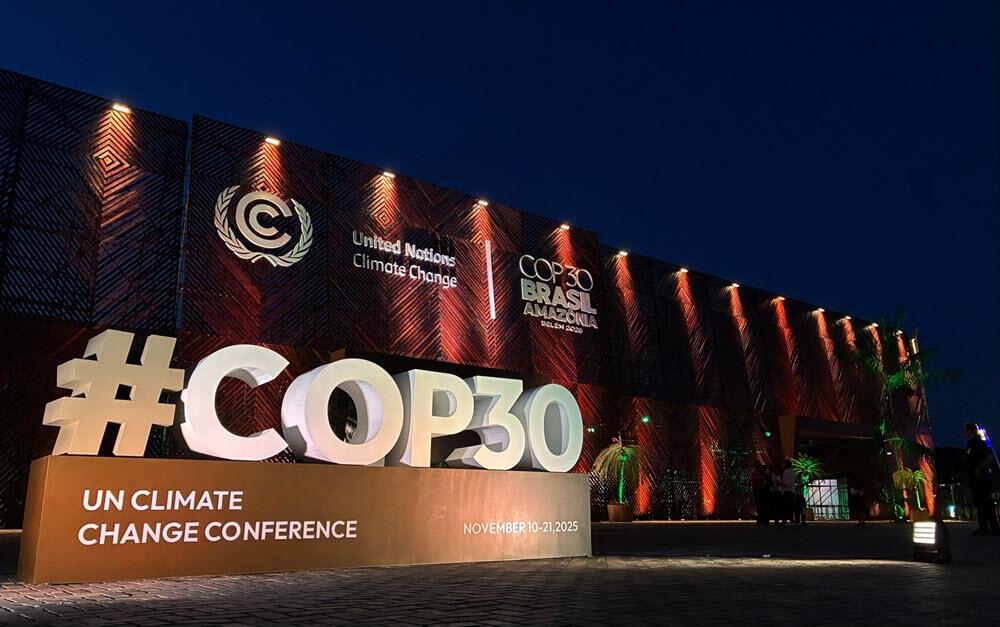
For the German Chancellor, one summit follows another. After the steel summit, Friedrich Merz now heads to COP30 in Brazil, the gathering of the climate club. There, participants attempt to cover the visible cracks in their construct with the familiar climate panic.
The steel summit at the Federal Chancellery was still echoing in the media when the Chancellor was already on a plane—en route to Belém, Brazil. COP30 is taking place these days under the leadership of Brazilian President Luiz Inácio Lula da Silva.
Representatives from over 70 nations have been celebrating this annual pinnacle of the global climate circus since 1995, giving it the veneer of supranational consensus. Of course, they travel by the thousands—by plane, how else—and with maximum emissions.
No one voluntarily skips the annual climate gala. A few tons of CO₂ really don’t matter anymore. After all, as insiders know, the planet is already burning, and the struggle for a habitable Earth is, in essence, already lost.
Indulgence Trade and Business
Yet, the grand figures of the climate industry wink and suggest there might still be hope for Earth. From Ursula von der Leyen to Lisa Neubauer and even the Chinese delegation, it is understood that massive investments in the green art economy might just pull the iron out of the fire.
As in spiritual circles, a little indulgence here, a CO₂ tax hike there, and magically the global temperature falls to acceptable levels—the climate god appeased.
Friedrich Merz undertakes the 9,000-kilometer journey from Berlin to Belém to assure his fellow indulgence merchants of continued German taxpayer support.
Redistributing the Wealth
The club plans to invest €1.3 trillion annually in climate measures for developing and emerging countries. Germany, as one of the supposedly strongest economies, must naturally participate. With the United States leaving the alliance, showing presence is crucial.
Merz had to travel, regardless of domestic issues. Cynically, his speaking slot was exactly three minutes. Three minutes for the envoy of the club’s hardline faithful—almost heretical considering Germany’s financial contributions.
Before the final boat ride on the Amazon, the Chancellor will lecture on industrial transformation and the energy transition—topics few have mastered as thoroughly as Germany’s top representative.
A Sad Comedy
At least in Brazil, Merz can proudly claim that Germany may meet its climate targets. Massive deindustrialization makes this possible. While UN chief António Guterres demanded radical action at the start of the event, warning in his usual panic that the 1.5° target has already been missed, the Chancellor performs his sad comedy.
Around 300,000 industrial jobs have been lost in Germany in recent years due to soaring energy prices and overreaching climate regulation. The country struggles economically and risks becoming a European Rust Belt under the climate timelines dictated by figures like Guterres.
Self-referential events like COP30, which knowingly ignore the economic fallout of hardline climate policies, distort reality, making it hard for the public to connect climate politics with economic decline.
Deep Cracks in the Construct
Since the peak of the climate movement in 2009, when US President Barack Obama legally declared CO₂ the most dangerous of all climate gases, the construct has shown deep cracks.
The Trump administration repealed this rule, and the US will fully exit the climate club on January 1, 2026, delivering a blow to the movement. Massive capital shifts follow: away from green funds, toward sectors that generate real market returns.
In the US, money flows back to nuclear and conventional energy. Renewables must now compete, as in a real market economy. True progress through free markets.
The climate movement still fails to grasp that technological progress toward cleaner, efficient, and sustainable production was driven not by the state but by market forces—materialized through price mechanisms, not socialist central planning.
China and India
The anachronism of Germany’s industrial retreat is stark where new capacity emerges—in India and China. Both ignore the rules of the Europe-dominated climate club.
India barely acknowledges them, while China plays an intelligent, though ethically questionable, game with Western climate zealots. Through a network of government-funded NGOs, Beijing has long helped anchor the European climate regime politically and in the media, while massively scaling export-oriented production like solar panels, following different domestic paths.
This year alone, China will bring 80 GW of new coal capacity online, invest in nuclear, and, where market-viable, in renewables—pragmatically and unideologically, the Chinese way.
The Taxpayer Cash Cow
From the EU perspective, COP30 must be seen for what it is: a media spectacle designed solely to keep the European climate subsidy machine running at full throttle.
The EU Commission plans around €750 billion for climate subsidies from 2028 to 2034, on top of national subsidies and aid. A massive business, with “partners” of the climate movement holding out their hands for European tax funds through development aid and countless climate funds.
Merz himself knows this game is flawed. Before the summit, he repeatedly stressed that climate protection is central, but must be pursued while safeguarding economic competitiveness and technological openness.
Yet, experience from the first half-year of the Merz government shows that the Chancellor will not challenge Brussels’ destructive climate policies. The combustion engine ban remains; the senseless heating law continues, costing German households billions. The mantra: stay the course, with industrial electricity prices and other subsidies, straight into economic decline.
* * *
About the author: Thomas Kolbe, born in 1978 in Neuss/ Germany, is a graduate economist. For over 25 years, he has worked as a journalist and media producer for clients from various industries and business associations. As a publicist, he focuses on economic processes and observes geopolitical events from the perspective of the capital markets. His publications follow a philosophy that focuses on the individual and their right to self-determination
Tyler Durden
Mon, 11/10/2025 – 02:00