
Justice Department Quietly Reverses Clinton-Era Rule On Immigrant Welfare Benefits
For almost 30 years, a key part of America’s 1996 welfare reform laws has existed mostly on paper after the Clinton DOJ effectively nullified it with a loophole. Now, the Trump DOJ says it’s time to enforce those laws as Congress originally wrote them.

Earlier this week, the Justice Department’s Office of Legal Counsel quietly reversed a Clinton-era legal opinion that had sharply limited when immigrants could be denied federal welfare benefits. The earlier interpretation narrowed the law so much, critics say, that it allowed many immigrants – including some who were not lawfully eligible – to continue receiving benefits Congress intended to restrict.
The new DOJ opinion restores a broader reading of the law, potentially expanding waiting periods for benefits, strengthening sponsor repayment requirements, and closing loopholes that have existed since the late 1990s.
What Congress Intended in 1996
In 1996, Congress passed the Personal Responsibility and Work Opportunity Reconciliation Act (PRWORA) along with major immigration reforms. The message was straightforward: immigrants should be self-sufficient, public benefits should not encourage immigration, and American taxpayers should not be responsible for supporting new arrivals.
To enforce those goals, Congress created several rules:
-
Most lawful permanent residents were barred from receiving “means-tested” federal benefits during their first five years in the U.S.
-
Family members who sponsored immigrants had to sign legally binding affidavits promising to support them.
-
If a sponsored immigrant received certain benefits, the government could seek reimbursement from the sponsor.
-
When agencies evaluated eligibility for benefits, they were required to count the sponsor’s income as part of the immigrant’s resources.
Congress defined “federal public benefit” broadly but never formally defined the term “federal means-tested public benefit.” That gap would become critical.
How the Clinton Administration Narrowed the Law
Early drafts of the 1996 legislation included definitions that covered any benefit based on income or financial need. But during Senate debate, those definitions were removed for procedural reasons tied to budget rules – not because Congress rejected them on policy grounds.
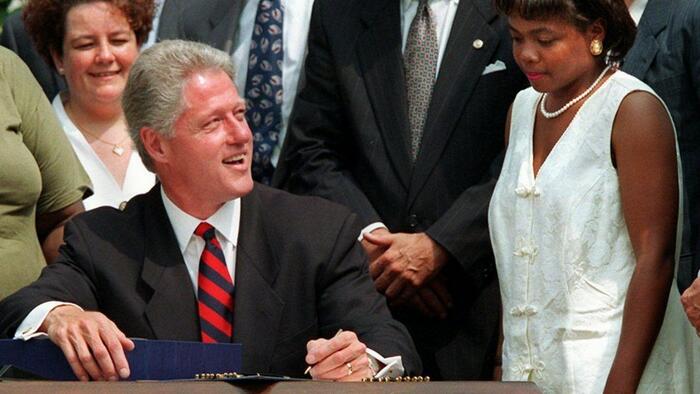
In 1997, the Clinton Justice Department issued a legal opinion arguing that because the definition had been removed, the law was ambiguous. The administration concluded that “means-tested” benefits should include only mandatory programs like Medicaid and cash welfare – and not discretionary programs funded annually by Congress.
As a result, for nearly three decades, most of the law’s enforcement tools applied to only a small number of programs. Many other benefits that also rely on income tests remained available.
Critics argue that this interpretation effectively gutted large portions of welfare reform and allowed immigrants – including some who were not legally eligible – to access benefits Congress sought to limit.
The Justice Department’s new opinion withdraws that 1997 interpretation.
The shift follows last year’s Supreme Court ruling ending the practice of courts deferring to agency interpretations simply because a law is ambiguous. Instead, agencies must now apply what they believe is the statute’s best reading.
Using that standard, the Justice Department concluded that “means-tested” plainly refers to any program where eligibility or benefit levels depend on income or financial need – regardless of how the program is funded.
Read the full opinion here: https://t.co/cs8aWICHho
— Eric W. (@EWess92) December 18, 2025
The new opinion also notes that the law specifically exempts certain discretionary programs. According to the Justice Department, those exemptions would make little sense if discretionary programs were never covered in the first place.
For a deeper dive that includes legal machinations underpinning the move, the DOJ effectively just implemented exactly what George Fishman from the Center for Immigration Studies recommended in this article from September, though Fishman recommended an executive order to redefine the term vs. an OLC opinion that requires follow-on agency action.
What This Means Going Forward
The decision does not immediately cut off benefits or change eligibility rules. Federal agencies will need to review their programs and decide how to apply the new interpretation.
But the implications are significant. The ruling could:
-
Expand the five-year waiting period for benefits
-
Strengthen enforcement of sponsor repayment obligations
-
Restore income-deeming rules that have rarely been used
-
Reduce taxpayer exposure to benefit costs Congress sought to avoid
Supporters say the move simply enforces the law as written and restores the original intent of welfare reform. Critics warn it could reduce assistance for vulnerable populations and lead to legal challenges.
What is clear is that a long-standing executive interpretation – one that shaped immigration and welfare policy for a generation – has now been undone. The Justice Department has reopened a debate that many assumed was settled, signaling a renewed emphasis on enforcing immigration and welfare laws as Congress designed them.
Tyler Durden
Fri, 12/19/2025 – 19:40