
How Resilient Is BRICS In The Storm Of Geopolitics?
Authored by Peter Hanseler / René Zittlau via ForumGeopolitica.com,
BRICS is a huge power factor whose members, partners, and candidates are currently undergoing a severe test. Today, we look to the future.
Introduction
In the first part of this series, we looked at the facts about BRICS and the major economic trends that can currently be observed.
The second part dealt with the environment in which BRICS must develop as the most important organization of the Global South. We assessed the warlike circumstances in general, the great danger that would arise from a nuclear war, and the unpredictability of the geopolitical situation, which leads us to describe the current situation as a “storm.”
In this third and later fourth part, we will first highlight the aggressive attitude of the US toward its friends. We will then point out the difficult economic situation in the US, which appears better than it is due to the AI hype. Finally, we will describe the US's efforts to maintain its hegemonic status in various geographical catchment areas.
Aggression Above All – Against Everyone
It does not take a genius to see that the tug-of-war between the Global South and the Collective West is already in full swing. We will discuss this further below, using specific examples.
“If you have America as a friend, you don't need enemies.”
However, the aggressive approach of the United States is not limited to members of the Global South or BRICS exponents, but is directed against anyone from whom there is something to be taken. This includes countries that are “friends” of America – such as Switzerland – or American colonies, such as most members of the G7 and others. See my thoughts on the “colonial empire of the US” in the article “The war between two worlds has begun – Part 1.”
Trump's approach toward friends and allies is so aggressive that one is inclined to say, “if you have America as a friend, you don't need enemies.” There are solid reasons for this aggressive behavior. On the one hand, Trump has set himself the goal of reindustrializing his country. This comes after Wall Street bankers, supported by President Clinton and his successors, deliberately deindustrialized the country just to line their own pockets in the short term.
This strategy also had the side effect of exacerbating income inequality among different social classes, which meant that a few people benefited greatly from this strategy while many industrial workers lost their jobs and became impoverished. Another consequence of this is the loss of industrial expertise among the population.
Trump has realized that he needs to do something. However, I doubt that he intellectually understands multipolarity and thus the concept of BRICS. He doesn't even have a clue which countries belong to BRICS. On January 21, 2025, he asked journalists whether Spain was a BRICS nation.
Furthermore, in January 2025, Trump still believed that he could bring BRICS to its knees simply by imposing tariffs and sanctions. He also threatened BRICS for not using the dollar:
"We are going to require a commitment from these seemingly hostile Countries that they will neither create a new BRICS Currency, nor back any other Currency to replace the mighty U.S. Dollar or, they will face 100% Tariffs,"
Trump seems to have recognized that BRICS poses a threat to the US dollar's hegemony. The fact that the US has its own behavior to blame for the avoidance of the US dollar in the Global South, because the hegemon uses its own currency as a weapon, seems to be lost on Americans in their hubris, which makes the situation all the more threatening for the US. We have commented on this behavior by the US and its consequences on several occasions, including in the section “The use of the US dollar as a weapon leads to a decline in the use of the US dollar as a reserve currency” in our article “How BRICS could overcome its biggest challenge – payment settlement.”
The behavior of the US so far does not suggest that it recognizes the danger posed by a BRICS payment system without the US dollar. If that were the case, Trump would try to make the use of the US dollar as attractive as possible for the Global South, but he is not doing so.
His actions to date have been aimed purely and simply at generating revenue through tariffs and extortion. Extortion because, in the case of the EU, for example, in addition to imposing 15% tariffs, investments and arms purchases in the trillions were extorted (see, for example, Reuters). This approach looks like a typical American “quick fix,” probably to avert the complete collapse of the US federal budget.
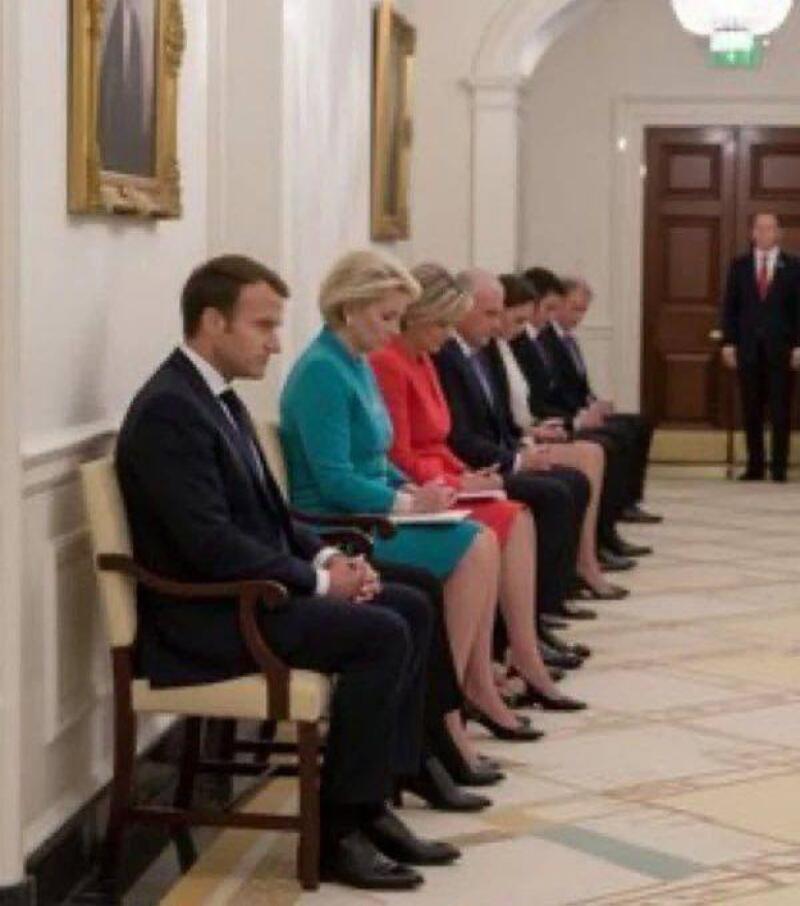
Fake but funny – AI can also be amusing – submissive European leaders wait to be dismissed by Trump – Source: Lucifer
The lack of intellectual understanding of the dangers that BRICS actually poses is also the reason why Trump sees China as a major adversary and fears that the Chinese are seeking to knock the US off its pedestal as the world's dominant power. For Trump, who prefers simple paradigms, this is easier to understand and communicate than the BRICS constellation, which the US population neither knows nor comprehends.
The Economic Situation in the US
If we are to believe the statements made by Jerome Powell, Chairman of the US Federal Reserve, at his last press conference on October 29, there is no cause for concern—at least that is how it sounds.
"the economy looks like it’s solid and stable and hasn’t really changed"
Transcript of Chair Powell’s Press Conference October 29, 2025
The term “looks like” already indicates that this whitewashing is built on sand.
Anyone who does not get his information from sources sponsored by banks and other financial organizations, such as CNBC and other mass media outlets that claim to be “experts,” but instead looks behind the scenes and occasionally visits ZeroHedge, is well aware of the pitiful financial situation of the US, or rather the Collective West. We described this catastrophe and its origins from a geopolitical perspective in our article “The war between two worlds has begun – Part 1.” It is not the purpose of our blog to analyze economic data; others are better at that. Nevertheless, today we would like to point out a phenomenon that is characteristic of our time.
AI – The Mother of All Bubbles?
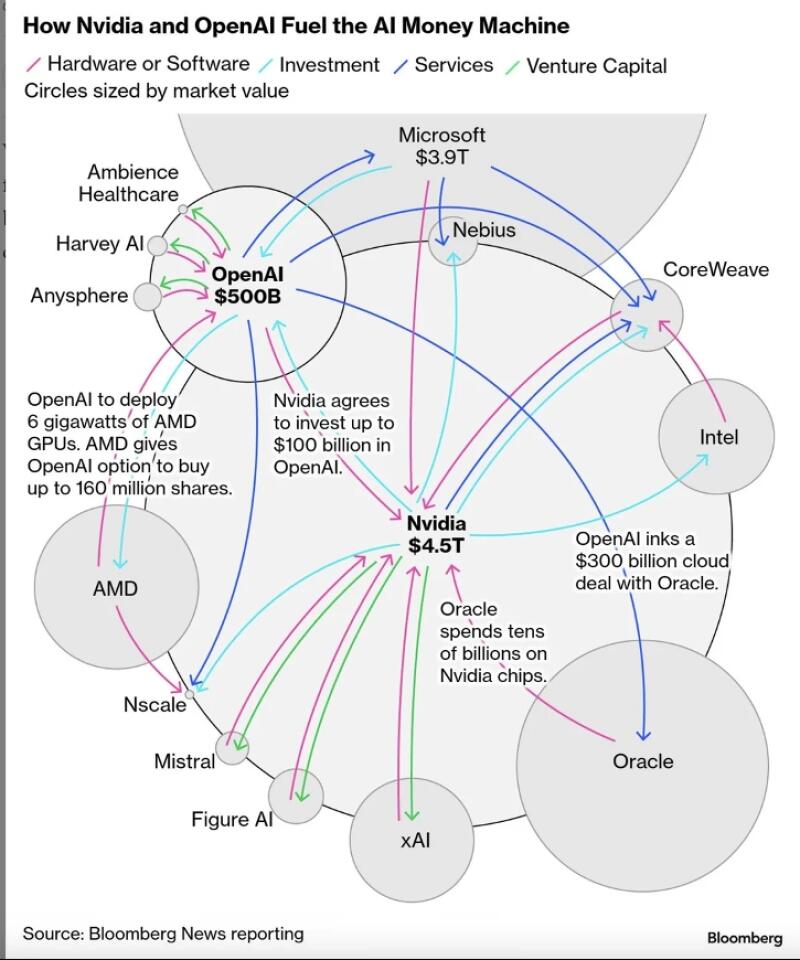
Those who view American stock indices as a benchmark for the economy are still cheering, albeit more hoarsely than before, as the price bonanza is limited to fewer and fewer stocks and AI is not only the savior, but must be the savior in order to keep the dance around the golden calf alive. The drivers of the stocks – people who tie their careers to this hype – dismiss objections that question how the predicted huge investments on which the valuations are based can even be raised and how a business model can be created in which users are supposed to amortize these huge investments. Most users pay a few dollars to use these artificial brains – nothing more. It is also striking that gigantic investments are passed around in a circle – according to the motto: You send me 100 billion under the heading X and I send the money back under the heading Y: Total investments then amount to 200 billion, but nothing has been invested. Instead of many: New York Times.
For those who want to have a laugh: Ronny Chieng explores the promises of AI
In 2000, there were companies listed on NASDAQ that had nothing to do with the internet, but added “.com” to their names and then saw their share prices jump by 500%. Something similar is happening again now. With these valuations, everyone can be sure that every pension fund in the Western world is invested in this bubble, because the big difference to the dot-com bubble is that back then, it was mainly high-earning doctors and lawyers who lost a lot of money when the bubble burst. Today, every pensioner is caught up in it.
According to the Swiss business newspaper Finanz & Wirtschaft, the current AI bubble (red) is almost twice as big—or rather, twice as bad—as the dot-com bubble of 2000.
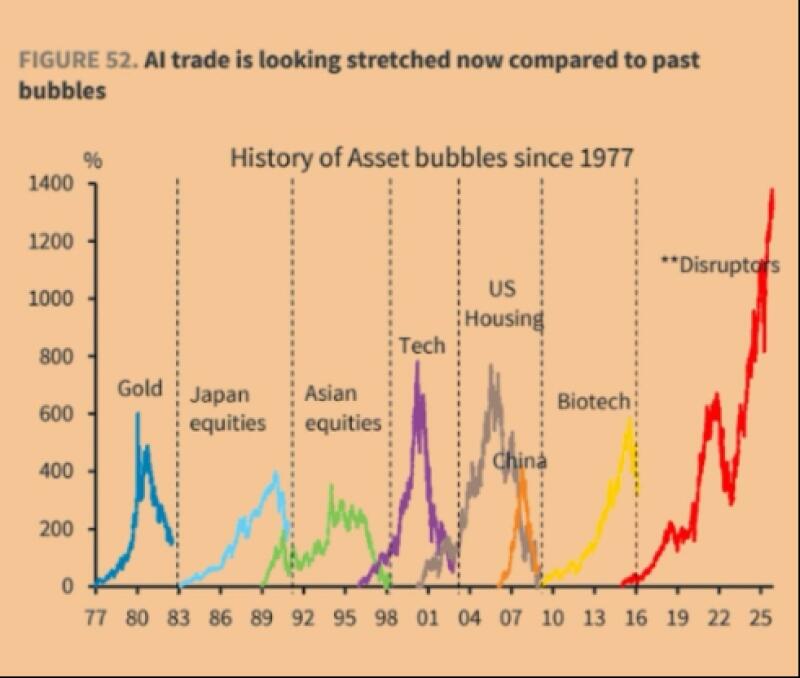
Source: Finanz & Wirtschaft
No one knows when this bubble will burst, but it will burst, and this will lead to such upheavals on the financial markets that the geopolitical plans of the Collective West will be called into question.
How Ill-informed is Trump?
To what extent Trump is aware of the catastrophic situation facing his nation and the financial markets in the Collective West seems once again difficult to assess. Trump himself—as a real estate mogul—loves the leverage of credit, which has made him rich and has repeatedly ensured that it was not he personally but his lenders who had to write off billions. Trump therefore loves debt and low interest rates. On December 3, 2025, the New York Times wrote:
"Mr. Trump has made clear that he wants a Fed chair who will support substantially lower interest rates, something that the central bank under Mr. Powell’s leadership has rebuffed given the economic backdrop. Inflation has picked back up with Mr. Trump’s tariffs, while the labor market has shown signs of slowing."
Source: New York Times
He is therefore unaware that lower interest rates will not only harm the US dollar in the long term, but that he will soon find no buyers for this currency. This circumstance would further reinforce the aversion of the Global South to the US dollar described above, as the US dollar would be shunned not only for geopolitical reasons, but also for purely economic reasons.
A close friend of mine is acquainted with someone who regularly dines with Donald Trump at the Mar-a-Lago dinner club. The talkative president speaks freely about many topics at these private gatherings. A few days ago, for example, he said that the Russian economy was in ruins and that the Russians were suffering catastrophic losses. I am on the ground here and can confirm to our readers that both statements are simply false. This is not about assessing the Russian economy or the situation on the front lines, but this example shows that President Trump is being misinformed by his advisors. Whether this is intentional or due to the incompetence of his administration, I have no way of knowing, but it does make his many suboptimal decisions this year seem more comprehensible, and one can assume that the president, who believes in simple thought patterns, sees the insane rally of a few AI stocks as a sign of a healthy and resilient economy.
How Will Trump Deal with BRICS?
Short-term Solutions to Money Problems
We have established so far that Trump is extremely aggressive economically and also very ruthless toward friends and allies in order to achieve his goals. His most pressing short-term goal is easy to identify: money. In May, we published the article “Mar-a-Lago will fail—without credibility, nothing works anymore.” In it, we critically analyzed Trump's economic plans. We demonstrated that these plans are partly contradictory and will ultimately fail due to the greatest weakness of the US: Americans are completely unreliable partners and only honor contracts as long as they benefit from them, only to break them afterwards for the flimsiest of reasons. We have already commented on this weakness of the US several times, for example in June in “Diplomacy on its deathbed,” where we quoted Professor Mearsheimer as follows:
"Any country on the planet to trust the United States is remarkably foolish."
Professor Mearsheimer
Medium- and Long-Term Solutions – Weakening BRICS
To achieve its medium- and long-term goals, the US is employing other means. As we have already outlined in our series “The war between two worlds has already begun,” the Americans are avoiding direct military confrontation with China and Russia. With regard to Russia, we believe that the confrontation in Ukraine is a direct one—see our comments in the second part of this series, “Has World War III already begun?” However, the Americans disagree, and the Russians are letting the Americans believe this for diplomatic reasons.
The US can only maintain its status as a hegemon if it destroys BRICS as an organization or weakens it to such an extent that it becomes what the West describes it as: a failed or embarrassing attempt by a few developing countries to rise above insignificance. In doing so, they are taking action against BRICS members, partners, and candidates, using every means imaginable. They are courting them to get them to switch sides (e.g., Saudi Arabia), weakening or destroying them (e.g., Venezuela).
Below, we outline the pressure points divided into geographical catchment areas on which the Collective West has or intends to exert massive influence.
Catchment Area: Western Flank of Russia
Ukraine
Currently, the Collective West is working on Russia in Ukraine in the Western catchment area. For the origins, I refer to my lecture of March 22, 2024.
The West has been conducting military operations for almost four years with absolutely no success. The losses suffered by the Ukrainians are horrendous, and it looks as though it will be the Russians who determine where their future borders will lie. It is very possible that Russia will turn Ukraine into a landlocked country by capturing Odessa, partly because of the ongoing attacks on Russian ships in the Black Sea, which are probably coordinated from London. Professor