
Dave Collum's 2025 Year In Review: From Precious Metals To Propaganda's Golden Age
Authored by David B. Collum, Betty R. Miller Professor of Chemistry and Chemical Biology – Cornell University (Email: dbc6@cornell.edu, Twitter: @DavidBCollum),
Every year, David Collum writes a detailed “Year in Review” synopsis (2024, 2023, 2022, 2021, 2020, 2019, 2018) full of keen perspective and plenty of wit. This year’s is no exception, with Dave striking again in his usually poignant and delightfully acerbic way.
This year's must-read Year in Review is a no-holds-barred exploration of propaganda’s golden age, AI’s rise, epic asset bubbles, precious metals surges, and the unraveling of truth in a technocratic world gone mad.
Click here for a PDF version of this report!
Table of Contents
-
Introduction
-
Podcasts
-
Metals
-
Investing
-
The Complacency Bubble
-
Tucker
-
Conclusion
Introduction
One of the definitions of sanity is the ability to tell real from unreal. Soon we’ll need a new definition.
~ Alvin Toffler, futurist
In the not-so-distant past, we would plan a trip in advance. There was no guarantee that there wouldn’t be mishaps, but our brains were wired in the open mode rather than the closed mode. I am reminded of my son’s road trip with friends to New Hampshire. They found themselves sitting at a dock with their gas gauge near empty at 11:45 PM in mid-December with the GPS instructing them to wait for the ferry…after the sun rises…in the spring. That, of course, is an extreme example of not seeing more than one move ahead.

The moment you realize the world is upside down.
We are now living in a technocracy that is changing too fast to metabolize, what futurist Alvin Toffler back in 1970 referred to as ‘future shock’. We travel through life guided by our metaphorical GPS; we no longer know the complete route to our destination, only the next turn, and it doesn’t always work. My internal GPS device is now randomly rerouting me, constantly flipping to new directions, causing dysfunction the magnitude of which will become clear shortly. Facts do not stay factual. The past is like a Tarantino film where history is rewritten to control the narrative. I can no longer trust my lying eyes. As Bret Weinstein so incisively noted, somebody has intentionally broken all of our fact-checking mechanisms.ref 1 (I adore Bret and his brain.)

Derinkuyu, Turkey, occupied circa 2000 BC
For 16 years I wrote what has been called a Year in Review. It started humbly as a synopsis of my investment returns with a few paragraphs of commentary that were on the top of my mind and shared among a handful of digital friends. Over time, it mutated into a bloated stage-IV growth spanning 250–300 pages summarizing a vast range of topics. I would plunge down rabbit holes, often finding rabbits, but occasionally I would hit Göbekli Teperef 2 or Derinkuyu.ref 3,4 I don’t debunk anything, because debunking implies that you start with a conclusion and set out to prove it. In a now-legendary debate on Joe Rogan’s podcast, Doug Murray argued that we are unqualified to share our views with a big audience unless we are credentialed experts, an argument that was utterly destroyed by uncredentialed comic, Dave Smith.ref 5 Nevertheless, whether I refute or merely offer my interpretation of events, the risk of coming off as an ignorant asshat is quite high or, as some might say, higher than normal.
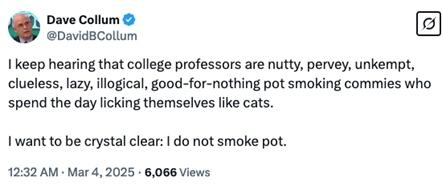
So why do I keep churning these out at the end of each year? What is in it for me? For starters, capturing the year’s events before they escape into the void where memories are lost appeals to me. Also, a half-century of studying chemistry—a fairly complicated subdiscipline of organic chemistry at that—has taught me that you do not have a functional, self-consistent model until you convert it to prose. Writing anneals disjointed thoughts and ideas into a coherent narrative and offers deeper insights that would be missed by simply being a passive observer. I also explicitly pursue topics that I know absolutely nothing about but want to explore through the process of writing—what I call writing my way to wisdom. Writing it once per year gives me time to gather data, ponder its meaning, discard the irrelevant noise, and focus on what motivates me. So I do it for myself, but my inner narcissist grazes on the credits and kudos coming from clicks, eyeballs, and dry humping of my leg while marinating in dopamine.
[Theodore Lowi] was the most insightful Cornell professor I had ever encountered until this “Dave Collum” feed showed up on X!ref 6
~ David Stockman, former Chief Economic Advisor to Ronald Reagan
Unfortunately, I unexpectedly began feeling like a prisoner in a gulag created by this daunting task. You cannot write a Year in Review in March, and projectile vomiting out 250–300 pages in the last couple of months of the year is insane. You need to have your A-game. The autumn writing season is not only rough on me but also on my wife. I am unreachable in my zone, which often leads to outbursts from my wife like, “Are you deaf? OK. I’ll do it myself God dammit,” which leaves me thinking, “What an odd way to start a conversation.”
It’s very pure. It is cheap to produce, and it has to be good for something. I just don’t know what.
~ Bob Moriarty on the generating hardcover YIRs
Many lurking issues came into focus when Bob Moriarty and Jeremy Irwin initiated a project to smack my total body of work—16 annual reviews totalling over 3,000 pages—into a bound anthology. (Bob also gets credit for publishing my first blog ever over 20 years ago under the pseudonym ‘Thomas’.) I had no idea why Bob and Jeremy were doing this, but they were determined to do the heavy lifting, so we began the task. Jeremy gets credit for massive editing and reformatting; Bob gets credit for providing the emotional support.
Try not to fuck up with the next books.
~ Bob Moriarty
While plowing through thousands of pages of proofs, I began to understand what my co-conspirators had intuited. The digital world began changing, imperceivably at first but with increasing acceleration over the last decade. Of course, the early writings seem quaint and naïve as I worked through the basic principles: I largely caught rabbits. But there was something more. I could assemble a jigsaw puzzle—the corner and edge pieces at first—and put together a reasonably coherent picture. The unimaginable or at least unimagined occasionally morphed into the undeniable.
Man has a limited biological capacity for change. When this capacity is overwhelmed, the capacity is in future shock.
~ Alvin Toffler, futurist
Political wonk Mike Benz noted that around 2013 the so-called Deep State—that shadowy group of characters who construct and promulgate narratives for mass consumption (pronouns: they/them)—was losing control of these narratives owing to the speed that information could travel via social media. A decade ago, we had a society-wide shared set of facts. This is no longer true. The puzzle pieces have become increasingly fluid; the undeniable now morphs into the questionable.
People of the future may suffer not from an absence of choice but from a paralyzing surfeit of it. They may turn out to be victims of that peculiarly super-industrial dilemma: overchoice.
~ Alvin Toffler, futurist
The 2024 Year in Review (YIR for short) was subtitled, “What is a fact?”, which expressed my growing frustration. Maybe I am personally running on fumes, but I suspect that my sources that seemed to dependably provide hard facts and hilarious anecdotes have become corrupted. I read articles on topics that should interest me but don’t, leaving me wondering if ChatGPT is creating sterilized narratives void of input from biological beings. AI-generated images were cute at first but lack humanity. Is writing suffering the same fate?
I think our reverence for the truth might have become a bit of a distraction that is preventing us from finding consensus and getting important things done.”ref 7
~ Katherine Maher (NPR CEO)
Although the sociopaths in control of wealth and power cannot keep gnarly details private (…mmm Pizza!), they can flood the zone with so much debris that it is nearly impossible to sort fact from fiction or to even stay focused enough to try. The signal is smothered with noise or what Adam Curtis called in the context of the Soviet Union, “hypernormalization.”ref 8
Propaganda is the executive arm of the invisible government.
~ Edward Bernays, father of modern-era propaganda
The elites grabbed control of mass media, social media, Wikipedia, and the farcically labeled ‘fact checkers’ to ensure that credentialed experts all sing from the same song sheet. We have entered the Golden Age of Propaganda. It is patently obvious to me that 9/11, mass shootings, assassinations (including Charlie Kirk), false flags, climate change, COVID and vaccines, and foreign wars are all a load of propaganda that would make the Godfather of propaganda, Edward Bernays, look like a poultry choker. They drive the manure spreader right into our homes. It is so garish, yet it works every time. Several podcasts describe the distortions created by modern propaganda—the digital world’s newest variant of hypernormalization.ref 9,10 Marc Crispin Millerref 11 and Chase Hughesref 12,13,14 are particularly incisive, but these inoculations will be only partially efficacious.
If something online pisses you off you are witnessing social engineering.ref 15
~ Chase Hughes (@NCIUniversity), an expert in influence, pursuasion, and human behavior.
If the opinion that’s coming out needs people to be silenced, then it is a psyop. If you can’t question it—if you’re supposed to just go along—it’s a psyop.ref 16
~ Chase Hughes
But didn’t the bad dudes—the Cornpops of the World—overplay their hand during COVID? Aren’t we now alert to those bastards’ dirty tricks? Maybe so, or maybe it was intentional. NBA legend Larry Bird would tell his defender what shot he was about to take, take it, drain it, and leave his defender a broken man. We all know JFK was killed by some organized group that is categorically called the CIA: so what? You need not keep a secret but only contain the public’s response. Channeling Larry Bird, Larry Silverstein told us they would pull building seven, they pulled it, and left the entire 9/11 narrative broken. So what? They lie to us. We know they lie to us. They know we know they lie to us. So what? They still give out the mRNA vaccine, support genocides (including yours Bibi), and claim to be the good guys defending democracy. We know they are lies, but so what?
To make a man forget the past, and blind him to the future, is as easy as making him drunk. The impression of invincibility is disaster itself. The stronger the illusion, the greater the fall.ref 17
~ Barbara Tuchman, The March of Folly
The markets offer yet another example. We are in what Jeremy Grantham calls our third and probably most epic asset bubble in only 25 years. We will be shocked for the third time when they rug us of our retirement savings. Bubbles serve a purpose by allowing pent-up cockeyed ideas to be tried. Three in 25 years, however, is not creative destruction but rather creative demolition. Larry Fink tells us his big investment ideas, sells them to us, drains our accounts, and leaves us broke and broken.

And now we no longer know what is real even if we see it with our lying eyes because of AI. I heard him say it! Are you sure about that? Do you trust Sam Altman? Did he have his coworker whacked?ref 18,19 Is he a genuine sociopath? An AI creation? Either way, the dead eyes speak volumes.

None of this document was written or even edited by AI. Explicit uses of Grok for information or entertaining answers have explicit attribution. Walter Kirn says AI loves em dashes. Well, so do I, so get over it. Experiments in which you recursively use AI to reprocess previous AI-generated results ultimately generate total garbage. Squeegeeing the drippings off the floor of the internet ultimately produces slop. What AI is showing us is why markets act so nuts. Computers are taking cues from other computers recursively with little or no human intervention, producing slop. As an aside, editing by two humans, my brother (Ned