
Cuba's Security-State Colonization In Americas, Proven By Delta Force Killing 32 Intel Agents Surrounding Maduro
Submitted by The Bureau's Michael Lima,
For years, the Cuban regime has insisted that its presence in Venezuela was benign—limited to doctors, nurses, and sports trainers offering humanitarian solidarity. The deaths of 32 Cuban military and intelligence personnel while defending Venezuelan dictator Nicolás Maduro have now shattered that fiction.
As early as March 2019, Cuba’s ambassador to Canada, Josefina Vidal, appeared on CBC News to denounce Canadian reporting on Cuba’s security intervention in Venezuela. She dismissed the claims outright: “The assertion that thousands of Cubans would allegedly be inserted into the structures of the armed and security forces of Venezuela, supporting the government of (legitimate) President Nicolás Maduro, is a scandalous slander,” she said, demanding proof.
Today, that proof is unmistakable. These men did not die treating patients or coaching athletes. They were killed as part of Maduro’s inner security ring, exposing Cuba’s central role in exporting its intelligence and repression model to keep authoritarian allies in power.
The Cuban Embassy in the United States honored, in an emotional gathering, the memory of the 32 Cubans who recently died in Venezuela and condemned the blatant violation of all norms of international law by the US government, which is exerting its imperial power over our America. pic.twitter.com/msX6PyMiP6
— Cuban Embassy in US (@EmbaCubaUS) January 6, 2026
This reality did not emerge overnight. Cuban-Venezuelan security cooperation dates back at least to 2008, when both regimes signed agreements granting Havana extraordinary influence over Venezuela’s armed forces and intelligence services. Under these accords, Cuba trained Venezuelan soldiers, restructured key military units, trained intelligence agents in Havana, and—most consequentially—reoriented Venezuela’s intelligence apparatus away from external threats and toward surveilling its own officers and commanders. This transformation proved vital to regime survival, allowing it to neutralize internal dissent and consolidate power for more than two decades.
That architecture of control became fully visible on January 3, 2026, during Operation Absolute Resolve, a U.S. military operation carried out by Delta Force and the 160th Special Operations Aviation Regiment that resulted in the capture of Maduro and his wife, Cilia Flores, and their transfer to the United States. On January 5, Maduro appeared in federal court in New York to face a four-count indictment accusing him of leading a 25-year narco-terrorism conspiracy.
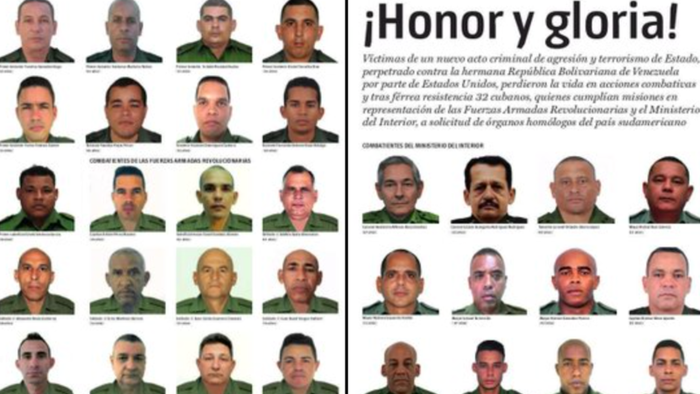
During the operation, 32 Cuban operatives from the Revolutionary Armed Forces and the Ministry of the Interior were killed while defending Maduro. Their deaths were not denied by Havana. On the contrary, the Cuban government confirmed both the casualties and their military ranks in Presidential Decree No. 1147, signed by Miguel Díaz-Canel, which also declared two days of national mourning. The decree amounted to an extraordinary admission: Cuban state forces were embedded at the highest levels of Venezuela’s security apparatus.
Those who talk about respecting sovereignty and international law in #Venezuela should explain why 32 of the 40 casualties of the US operation were Cuban thugs protecting #Maduro.#Cuba is the one that steals Venezuelan oil and violates international law and human rights. pic.twitter.com/UgzTYIlOhj
— Daniel Lacalle (@dlacalle_IA) January 6, 2026
Although the Cuban regime did not officially disclose their names, the independent Cuban outlet 14ymedio identified six of the deceased, along with their ranks and provinces of origin, using social media posts, private messages, and partial confirmations from local authorities. Most were from eastern Cuba, particularly Granma and Santiago de Cuba. Among them were Fernando Báez Hidalgo, 26, linked to the Interior Ministry’s Personal Security Directorate; Landy Osoria López, a State Security operative deployed in Caracas; and Yordenis Marlonis, reportedly part of the Venezuelan president’s direct protection detail.
Others appeared to belong to the Avispas Negras (Black Wasps), an Interior Ministry unit sanctioned by the U.S. Treasury for violently suppressing the July 11, 2021 pro-democracy protests. At least one of those killed was identified as a cryptographer.
The extent of this penetration was underscored days later by U.S. Secretary of State Marco Rubio, who stated that Maduro’s entire security structure was effectively controlled by Cubans—those who guarded him, those who monitored loyalty within the regime, and those who kept him insulated from his own people. The implication was unmistakable: Venezuela had not merely allied with Cuba; it had been colonized by Cuban intelligence.
This model of exported repression is not unique to Venezuela. A similar pattern has taken root in Nicaragua. Since the mass protests of April 2018, credible accounts from retired Nicaraguan military officers—including Major Roberto Samcam—indicate that dictator Daniel Ortega has increasingly surrounded himself with Cuban advisers embedded in his security apparatus, displacing Nicaraguan personnel who once formed his inner circle.
Independent reporting suggests that roughly 60 Cuban advisers operate within Nicaragua’s military and security structures, overseeing surveillance, loyalty screening, and repression. During Operation Clean-Up in April 2018, Cuban special forces reportedly operated alongside paramilitary units during mass arrests and the violent dismantling of civilian resistance—an archetypal case of the “Cubanization” of repression.
The military operation that led to Maduro’s capture signals a decisive shift in U.S. credibility and deterrence. For years, autocrats faced little cost as U.S. responses were limited to statements and sanctions that failed to change behavior. It would now be a strategic mistake for the United States—after executing such a sophisticated operation—not to pair it with a coherent political strategy to promote a democratic transition in Venezuela.
A democratic Venezuela—one that respects electoral results and the popular will, especially that of the more than 70% of Venezuelans who voted for Edmundo González in the July 28, 2024 elections—would halt the export of authoritarianism, dismantle state-sponsored narcotrafficking networks, help reverse the refugee exodus, and reemerge as a reliable energy partner.
Sustained oil production growth is unrealistic under a corrupt criminal regime; by contrast, JP Morgan estimates that a political transition could raise output to 1.3–1.4 million barrels per day within two years, and potentially to 2.5 million over the next decade.
History shows that democratic transitions fail when senior power brokers and regime institutions escape accountability. Figures such as Diosdado Cabello, Delcy Rodríguez, Jorge Rodríguez, and Vladimir Padrino López must face justice—or mafia-like structures will persist.
The eventual fall of the regime would have far-reaching regional consequences: deepening Cuba’s isolation, fracturing the authoritarian axis with Russia, curbing the influence of China and Iran, weakening ELN and FARC groups in Colombia linked to drug trafficking, and helping stem the largest mass exodus in Latin American history.
Despite the deaths of the 32 Cuban operatives, as long as the Venezuelan regime remains in power, many other Cuban intelligence advisers will continue to be embedded across multiple spheres of influence. These deaths reveal how authoritarian regimes sustain one another through intelligence sharing and the export of repression—regardless of the human cost.
Repressive regimes do not stand alone—they sustain one another. The Cubans who died defending Nicolás Maduro did so not in defense of Venezuela, but in defense of a repressive system responsible for crimes against humanity, torture, political imprisonment, enforced disappearances, and extrajudicial killings—a system built on surveillance, fear, and impunity. Their deaths mark not only the collapse of a security ring, but the unmasking of an entire axis of repression in the Americas.
Tyler Durden
Tue, 01/06/2026 – 11:45