
2025 Greatest Hits: The Most Popular Articles Of The Past Year And A Look Ahead
One year ago, when looking at the 20 most popular stories of 2024, we said that "while 2024 had a seemingly endless variety of social, economic, political, geopolitical and of course, financial and market, drama, the unprecedented onslaught of 2022 and 2023 – which saw both the deadliest and most consequential global war since WWII and a historic inflationary onslaught – simply proved too great to beat…. although we are confident that's only because the newsflow was merely resting ahead of 2025 when, thanks to the most consequential presidential election in modern US history, the coming avalanche of news and propaganda will be sheer insanity, especially since the Fed has made its long awaited dovish pivot without successfully stamping out inflation first. So in retrospect, 2024 being somewhat tame by recent standards may have been a good thing: it allowed everyone to rest ahead of the main event."
Boy, were we right, and in retrospect we certainly hope everyone did rest ahead of the countless 2025 main events because while 2025 not only saw what was the closest event to a market crash in years, it was almost a sideshow to the most exciting and eventful rollercoaster of non-stop newsflow we have yet encountered (in large part thanks to the daily torrent of stream of consciousness unleashed by the occupant of the White House) one which not only saw the legacy political system finally crumble across "Western democracies" as country after country said "no more" to the four-headed globalist hydra of runaway inflation, corrupt establishment politicians, uncontrolled illegal immigration, and targeted assassination attempts, but one where the political economy and capital markets proved beyond a reasonable doubt that they are more inextricably welded together than ever before. Oh, and of course, it was also the year when the Fed's apolitical facade crumbled, exposing the most important central bank in the world as nothing more than a puppet of shadowy establishment forces whose only task is to preserve the status quo.
But first, let's first take a quick look at what happened in the past year through the lens of the masses, and as a quick 4-minute refresher, here is a highlight reel from Googles "year in search" of all the big, if mostly irrelevant, topics that people around the world obsessed over in 2025.
Of course, all of the stuff in the clip above is just fluff and distractions for and by the masses, meant to keep attention focused on trivial things and away from what really matters. What we tried to do with our reporting throughout the year was to minimize the noise and to bring you, our readers, the signal, and while there was a nonstop barrage of the former, the underlying newsflow largely boiled down to four main categories:
- Political/Tariffs
- Technological/AI
- Financial/Central Bank Credibility
- Geopolitical
Starting with the first, the shock from the result of the November 2024 election – which together with the Trump assassination attempt were the biggest political events of 2024 – quickly turned to awe from Trump's decision to immediately implement his transformational trade policies in the form of massive tariffs on most US trade partners, which upended decades of conventional trade policy through significant action and led to a surge in the effective tariff rate and countless predictions of doom, gloom and recessions from such cartoon economists as Paul Krugman who said that "it's not the size of the trade policy shift, but the uncertainty around it that could cause a recession…. and at this point, policy reversals may actually worsen the situation because they would enhance uncertainty."
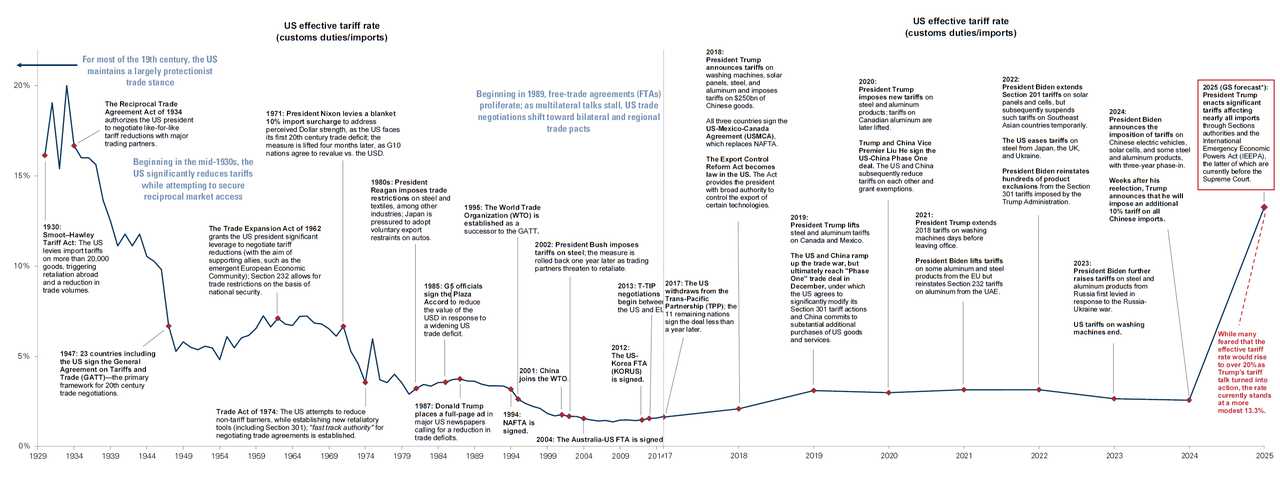
But what Krugman, and so many other "experts" failed to understand is that, in keeping with the pattern set by the first Trump admin the president was setting new precedent and aggressively negotiating, leading not to a recession, but many new trade deals – all at far more advantageous terms to the us – with little of the "imminent" inflation passing through to US consumers as it was exporters (such as Japanese car makers) who ended up footing the bill for Trump's tariffs.
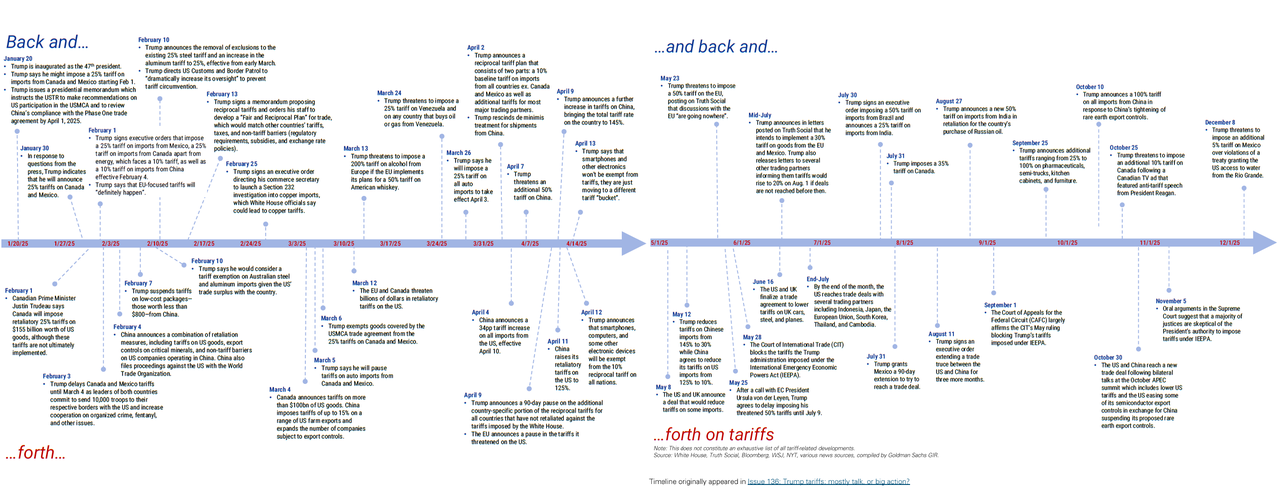
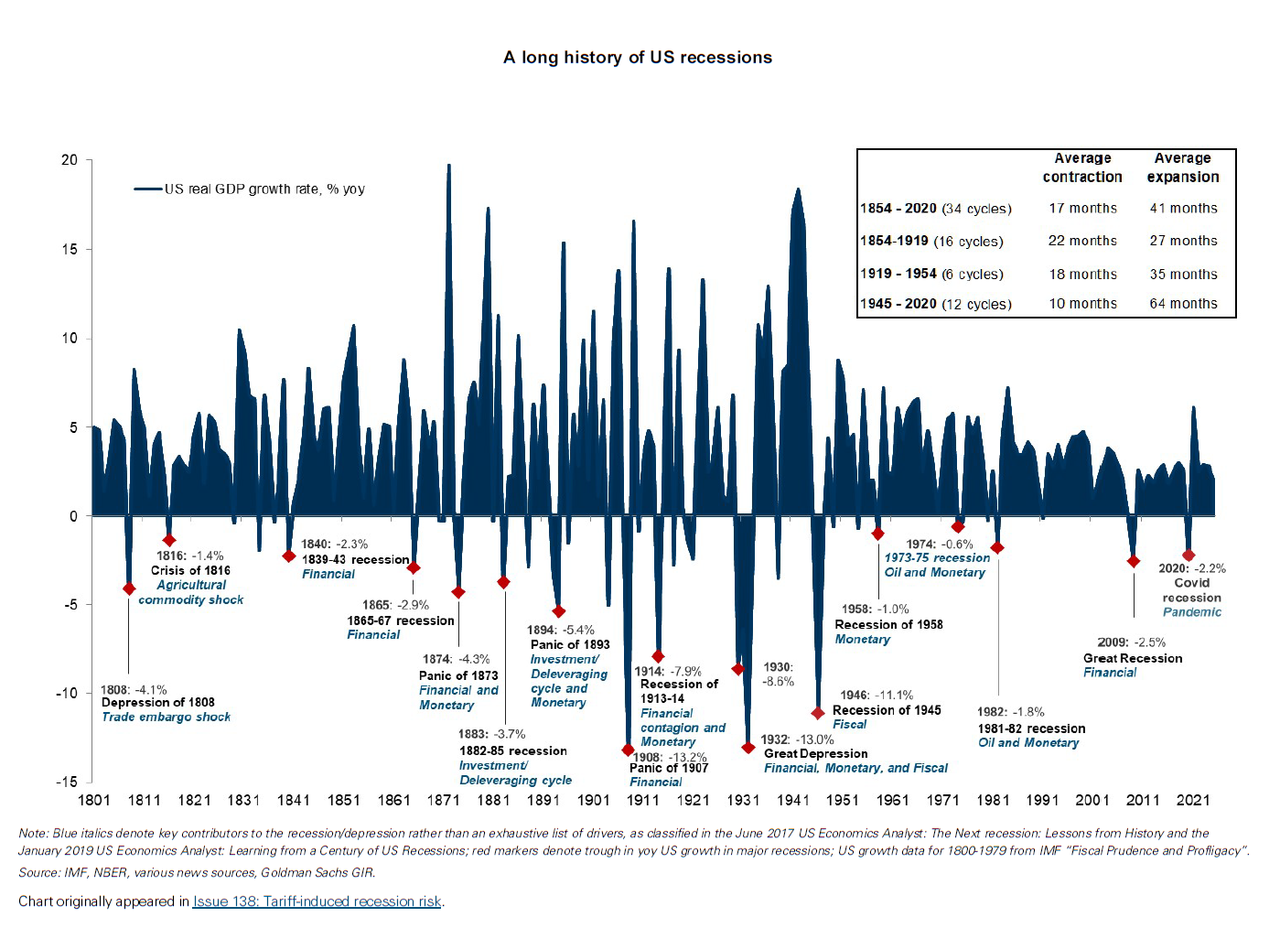
The result was that the initial surge in trade uncertainty, which was loudly cheered on by liberal economists as it confirmed their anti-Trump bias, promptly faded…

… and recession fears disappeared almost as fast as they had emerged.
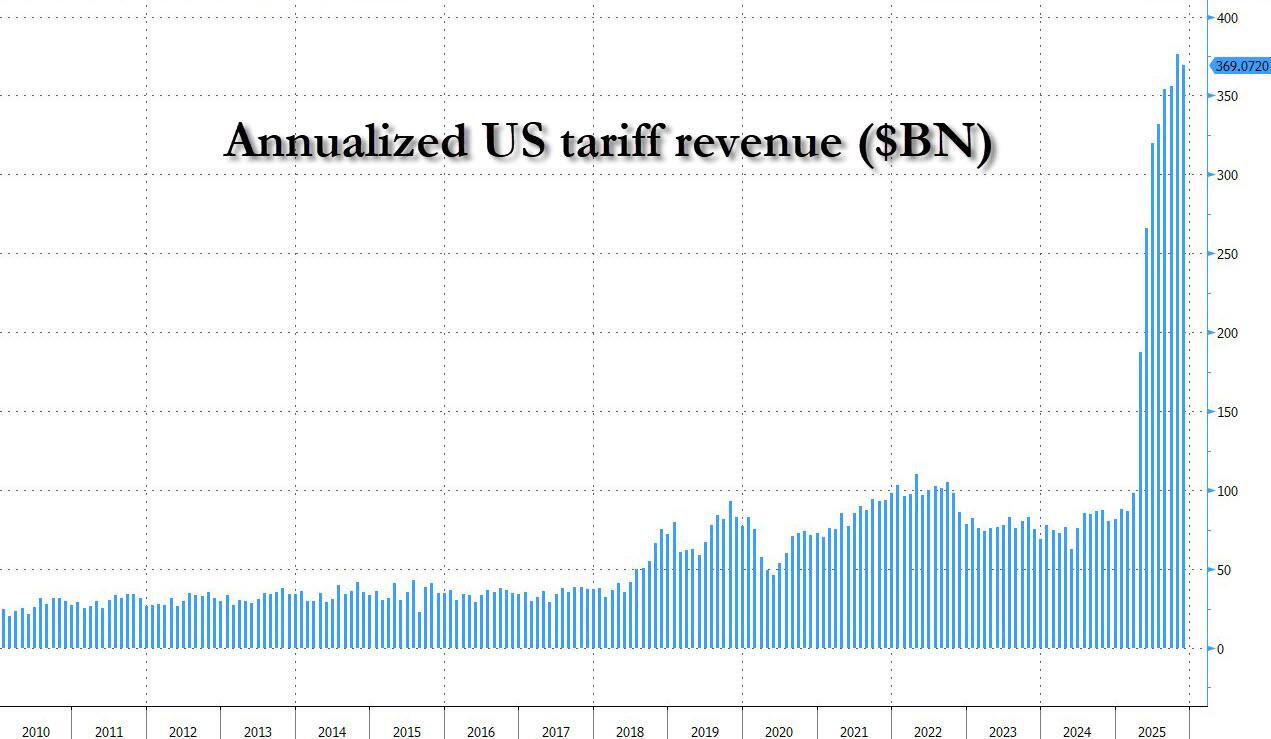
And while the inflation from Trump's tariffs has yet to emerge, the benefits in the form of almost $400BN in annualized tariff revenues are already here, and could have been used to lower the US budget deficit…
… if there was any hope that the US could ever spend less, which unfortunately is no longer feasible with the US starting fiscal 2026 with the biggest budget deficit on record….
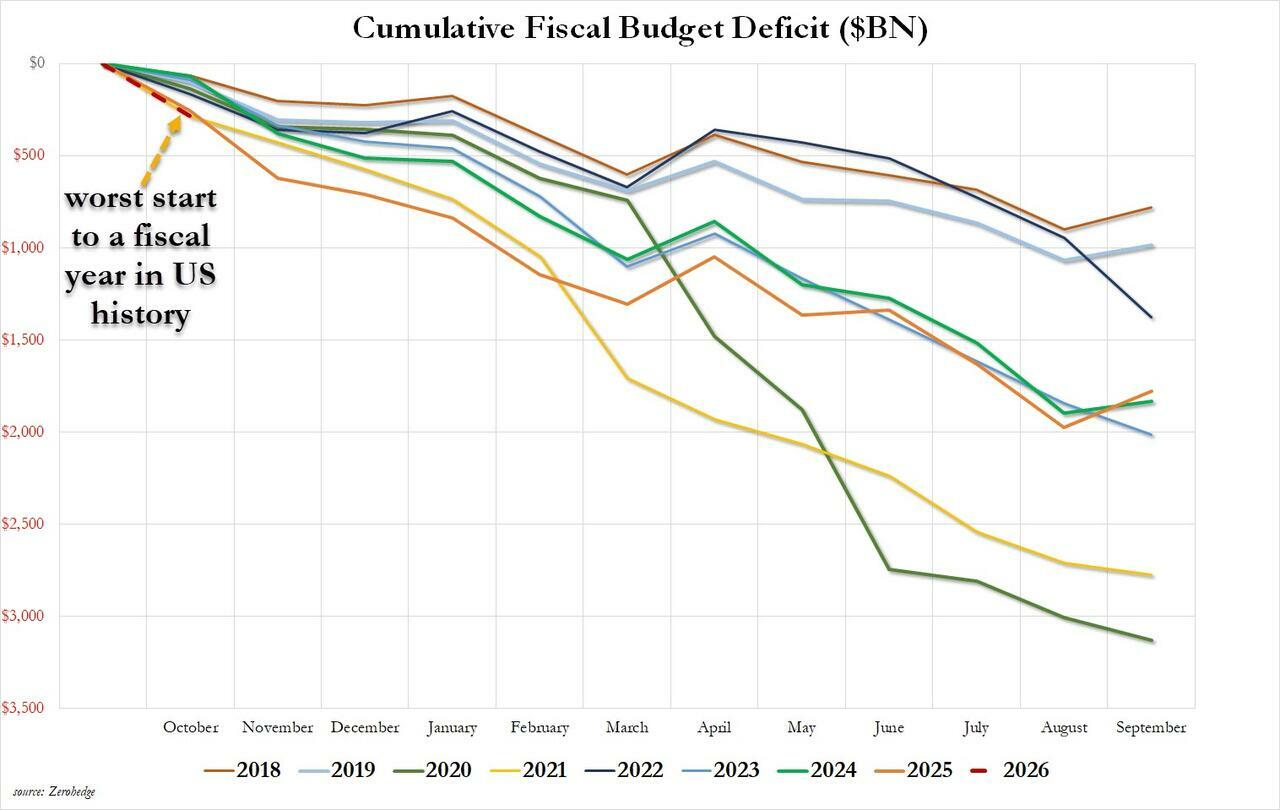
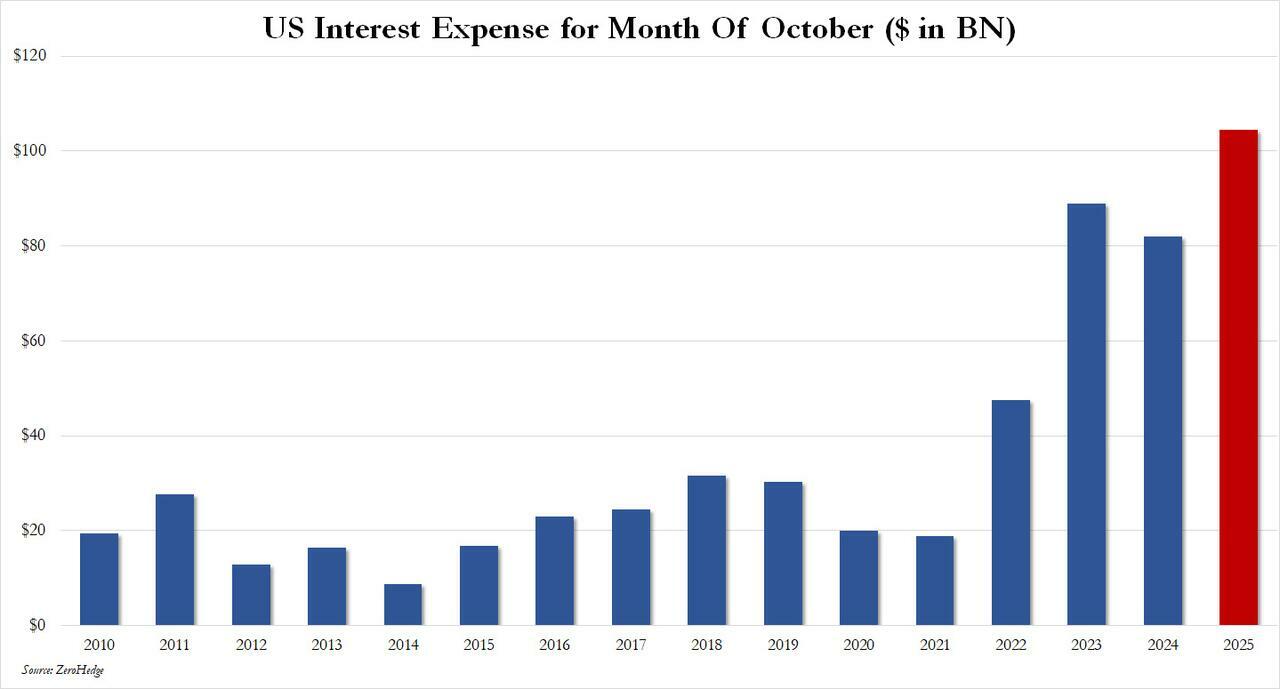
… largely due to the now recurring $100+ billion in monthly interest expense on US debt.
And while politics – and the constant daily declarations from Trump's Truth Social account – certainly meant much less sleep for anyone in 2025, one can certainly argue that innovation, in a broad sense, and especially AI technology, was as important as politics this year and certainly helped lift the US economy from a far worse place.
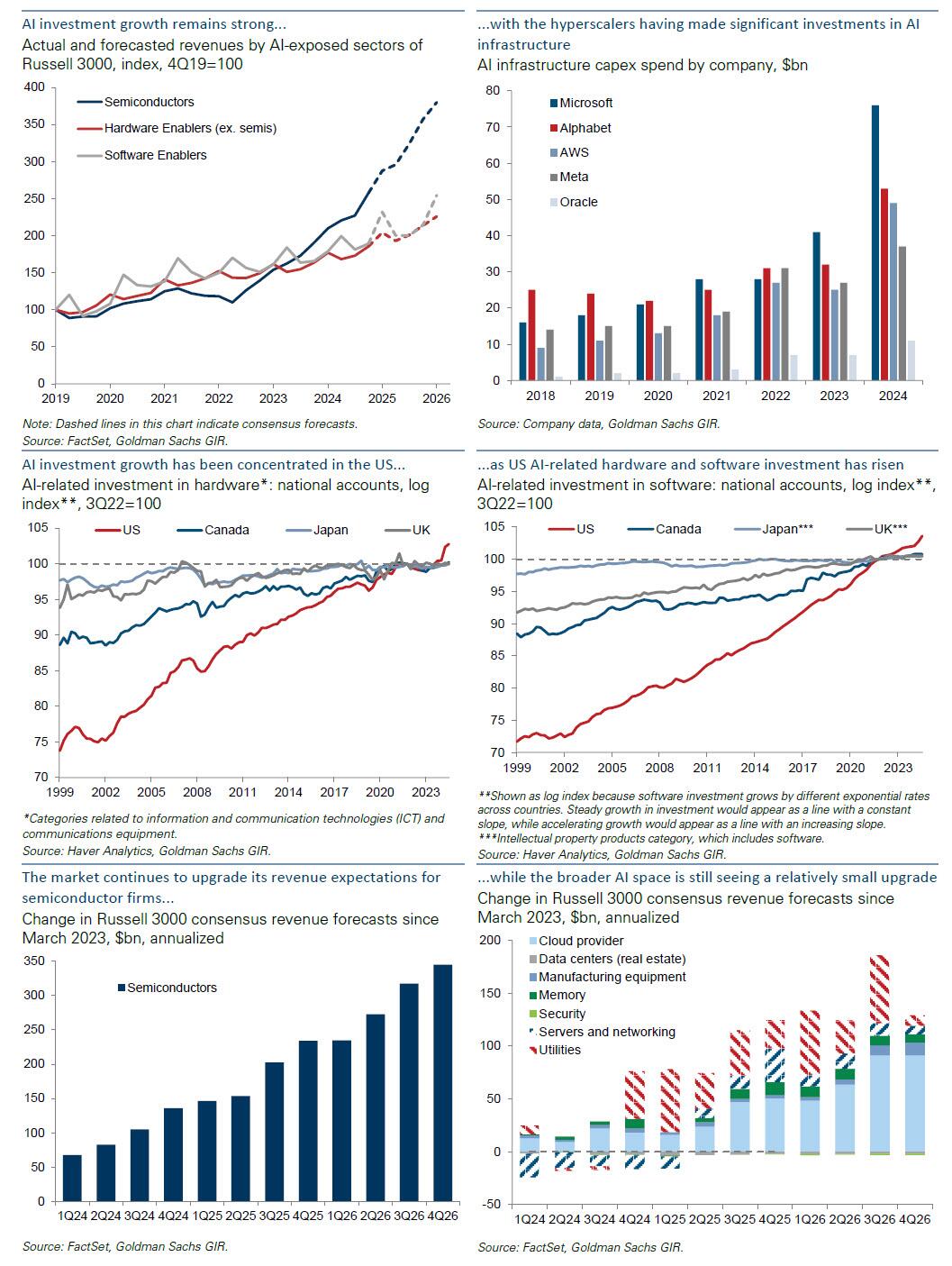
To be sure, the year started off on the right foot, with names that have become synonymous with the AI boom like Nvidia soaring, as Wall Street was content that investment in AI would continue to grow exponentially, as the following charts show.
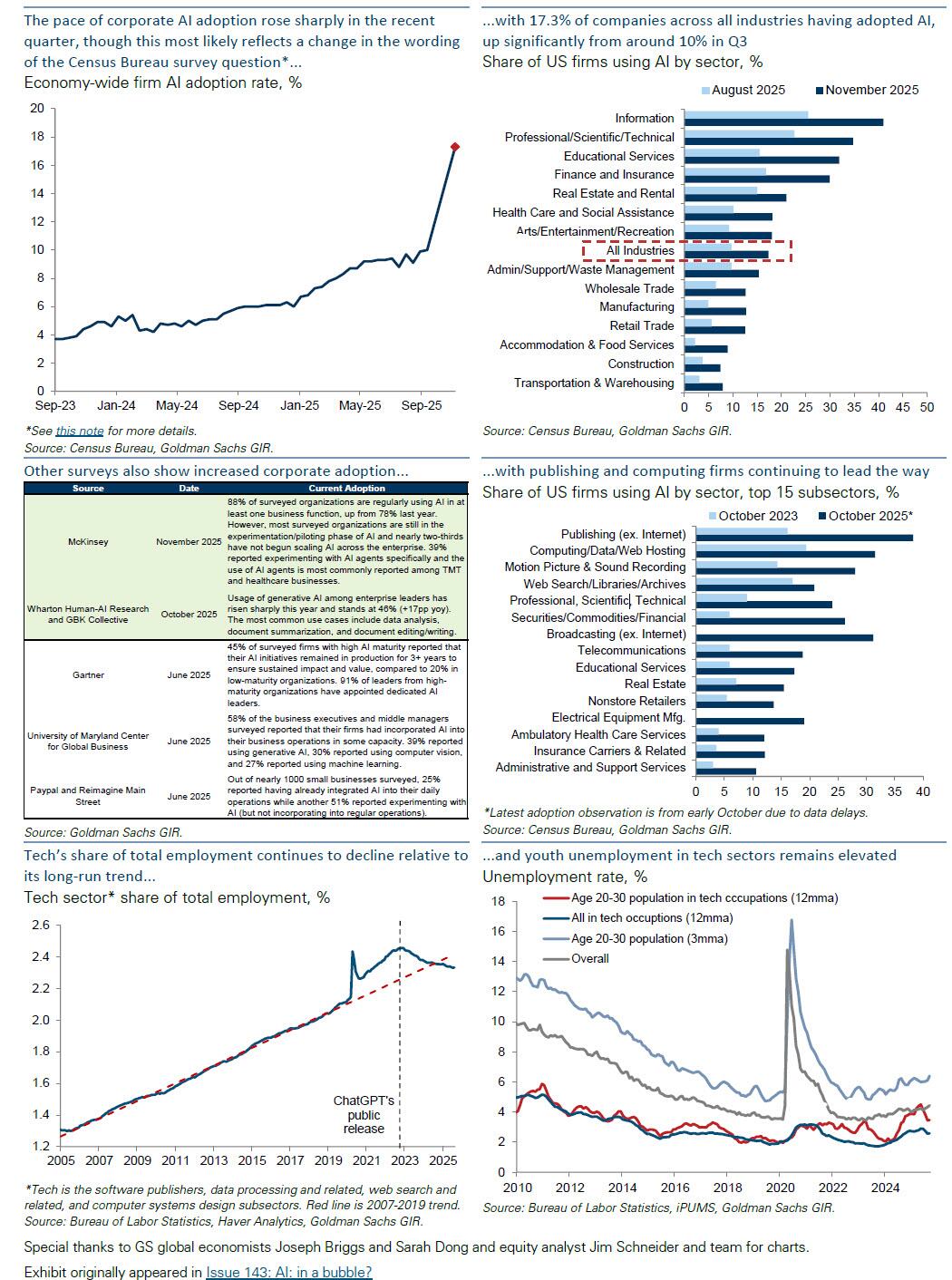
Optimism was also lifted amid reports that AI adoption was rising (even if as Goldman noted, it was due to a purposefully phrased question designed to give the impression that adoption was rising). The trade off to increased AI adoption – far more concerning in the short-run for politicians desperate for votes – is that both overall tech and especially youth unemployment, are rising dangerously fast, potentially leading to a sharp deterioration in the US labor market, assuming the AI cycle goes as planned… and the US wins the US-China AI war.
That outcome is far from certain, however, and it finally dawned on the market that the flurry of recent developments in the AI sector…
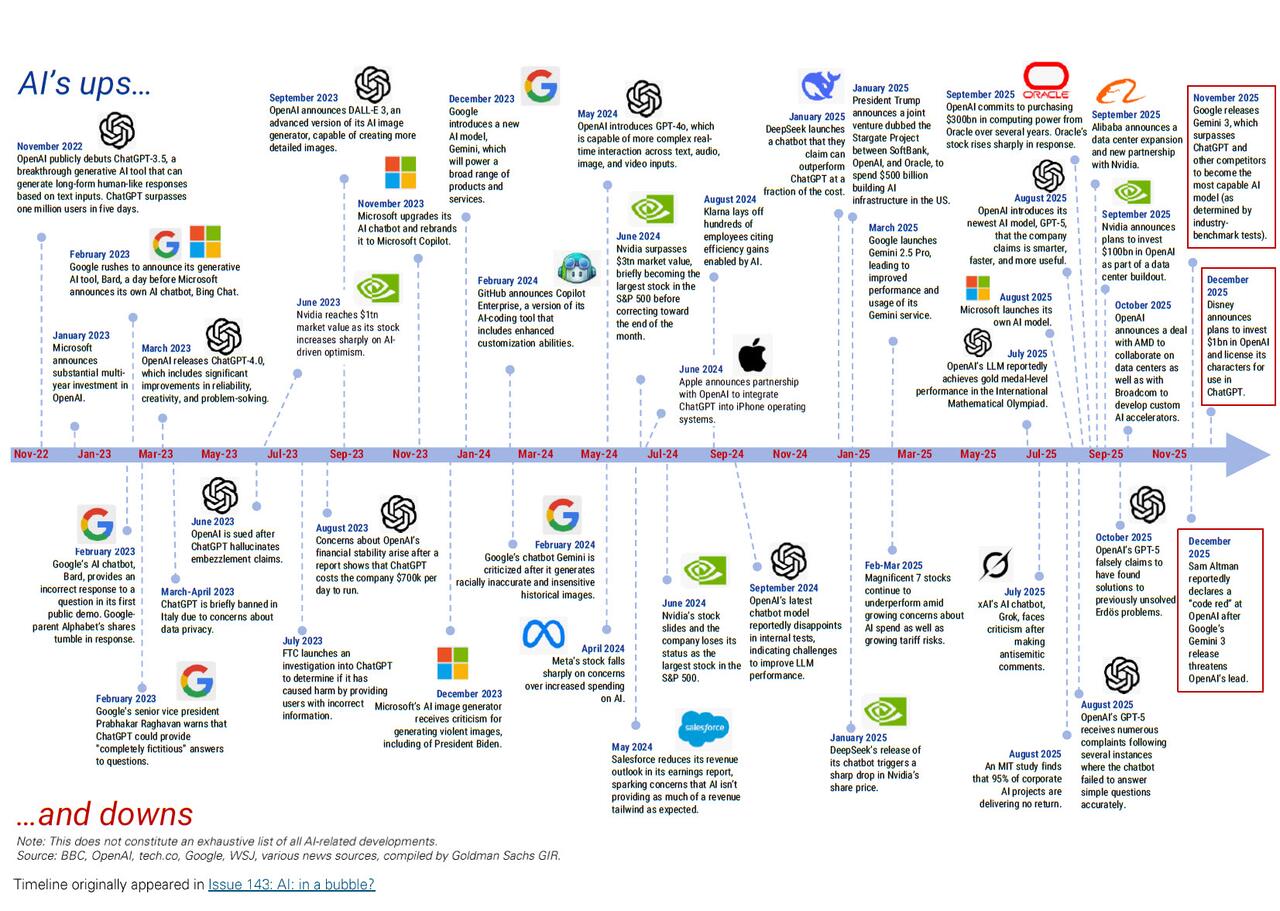
… was – as we first described it – one giant circle jerk, where little money actually changes hands yet the impression of top-line growth keeps pushing stock prices to record highs…

… resulting in a painful swoon for much of the AI sector in the second half amid renewed concerns about AI returns on investment, and the risk of a full-blown bubble which may burst any second
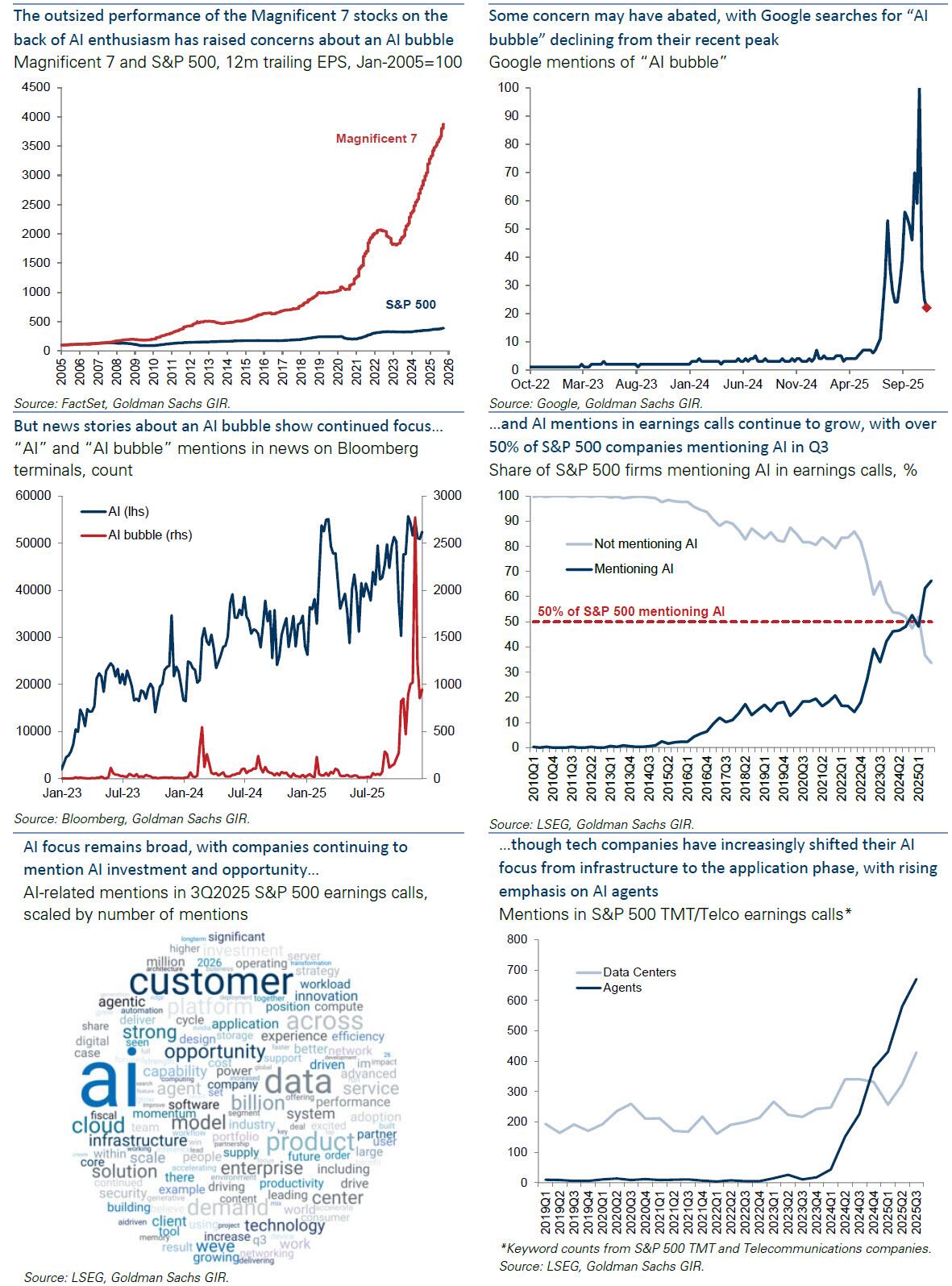
In any case, the reality is that we have seen chatbots come and go, and the world always moved on to a new, bigger and shinier fad. This time, however, prices may have pulled just a little bit too much from the future, as this breakdown of the Mag7 vs the S&P shows.
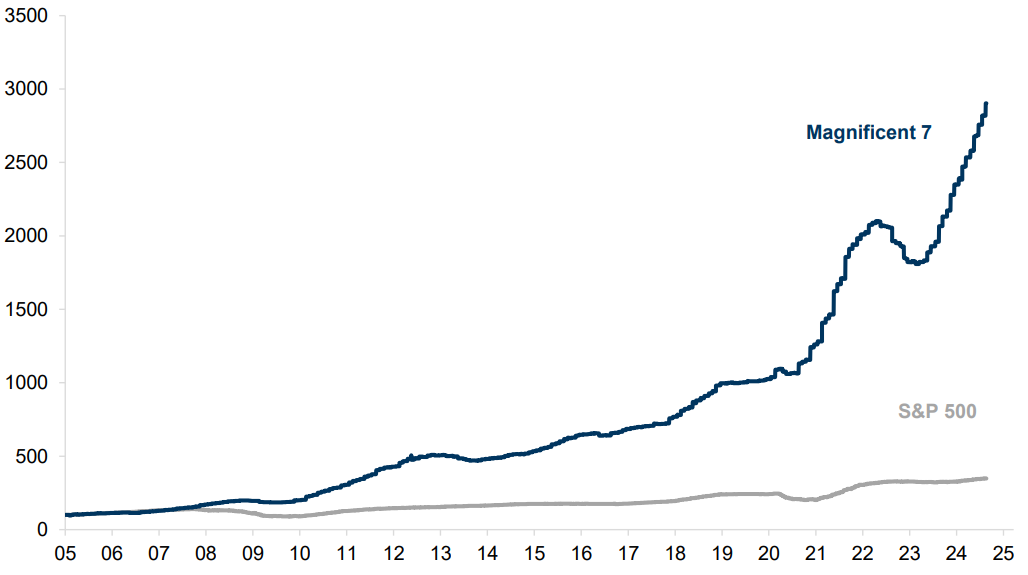
In any event, we don't have that much new to add here: exactly two years ago we said that "we would be remiss not to mention the single biggest market narrative – and tech story – of 2023, namely the unprecedented AI mania, which manifested itself in an explosion in the "Magnificent 7" mega tech stocks which now make up a record 30% of the S&P's market cap." Two years later, AI is still the the biggest driver of financial assets, and that will continue… until it stops.
Maybe the biggest difference from two years ago is that "more of the same" means that never before has so much market influence and impact been concentrated in so few stocks, and at last check, the 10 largest stocks in the S&P now account for 38% of total market cap. Actually, one correction: it's not "never before" – the last time so few stocks had such a big impact on the market was… just before the Great Depression.
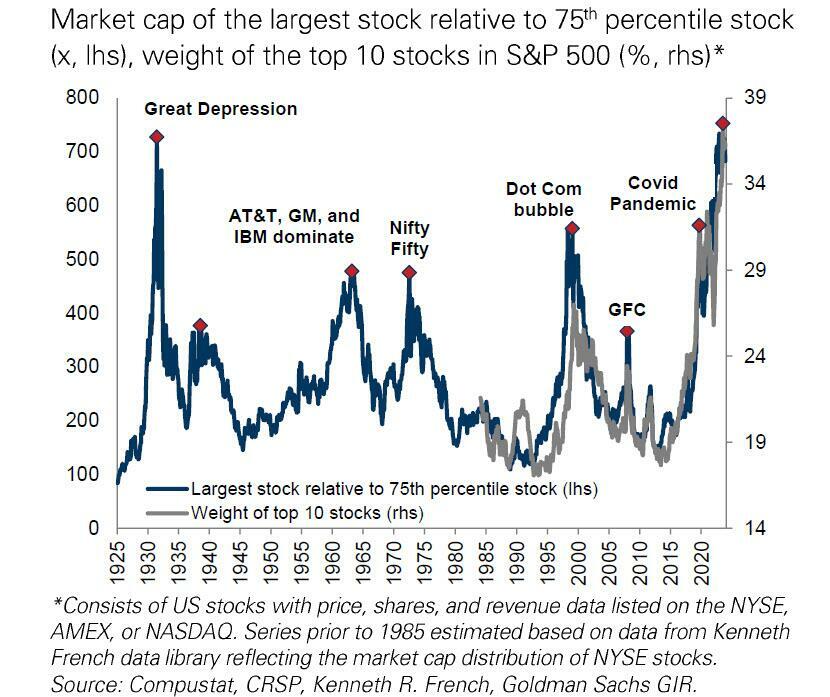
Actually, we do want to highlight one pretty notable change, and this one could be critical for the 2026 midterms: after two years of coasting on available grid capacity, the rampant data center buildout means that energy has officially become the bottleneck, and as the following chart from Goldman shows, eight out of the 13 US regional power markets are already at or below critical spare capacity levels.

Add to this the stark reality that Nvidia's upcoming Rubin/Rubin Ultra GPUs will be power hogs, raising the electricity demand for every rack from roughly 150kW to 300/600kW…

… and we stand by our claim made this summer that this chart of US electricity inflation – already surging in states like DC, Indiana, Illinois and NJ – will soon be the biggest political and economic talking point.
In one year, this will be the most popular chart on this site pic.twitter.com/h93gWXMoNL
— zerohedge (@zerohedge) August 11, 2025
Artificial Intelligence aside, another major technological innovation that also came to the fore in 2025, but received far less attention – even though it is possible its contributions to society will be just as important as AI – were stablecoins, a tokenized digital alternative to fiat currency which use blockchain technology and unlike cryptocurrencies, are designed to maintain a stable value, traditionally pegged one-to-one with the dollar (and collateralized by T-Bills, i.e., the more demand for stablecoins, the more demand for Bills) . In 2025 the value of the stablecoin market rose above $300 billion (with Tether accounting for more than half), and which many project will rise to $2-3 trillion over the next several years…
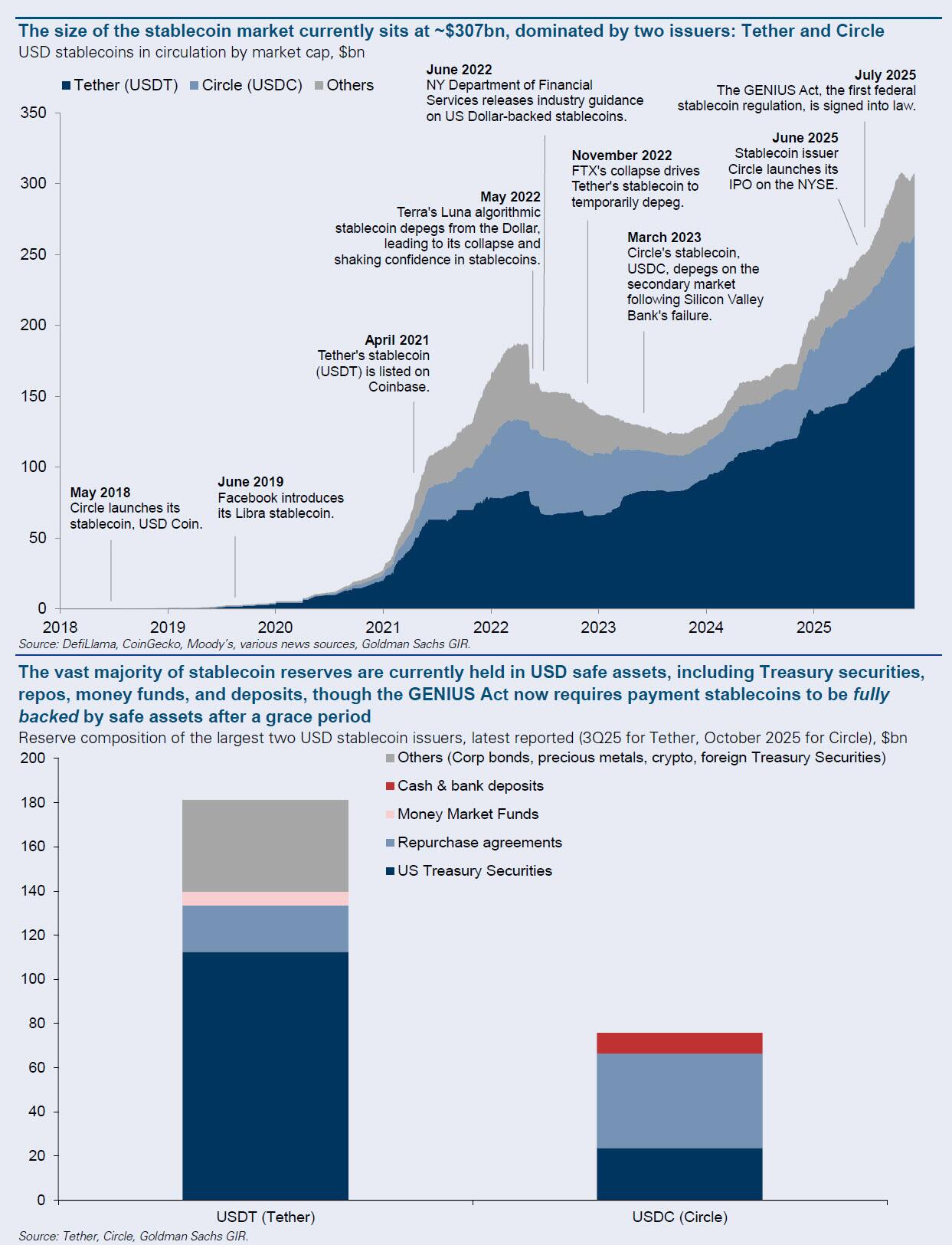
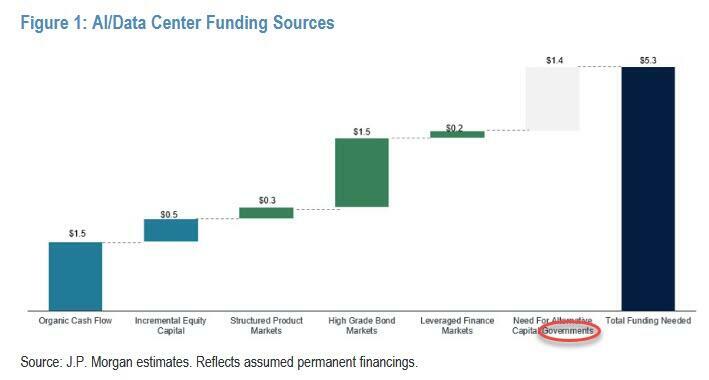
… providing a natural buyer of short-term debt and serving as a Plan B to the Fed's upcoming mega QE, because you didn't think all that debt that will be needed to fund the AI cycle – over $5 trillion according to JPMorgan – would buy itself.
And speaking of the Fed, our nemesis since day one of this website when gold was $700 and bitcoin didn't exist, it is gratifying to see that the US central bank is circling the drain ever faster, and is likely at most a few years away from losing its "independence" – which never actually existed – and merging with the Treasury. Until then, however, the question is when will it all fall apart, with both the debt and deficit hitting daily record h