

Here’s a round-up of news for Canadian investors this week.
Featured RRSP Accounts
featured
EQ Bank

Build your retirement savings with 2.00% interest, tax-deferred contributions and zero fees.
go to site
featured
Registered GIC rate
Earn a guaranteed 3.4% in your RRSP when you lock in for 1 year.
go to site
Best RRSP rates

See our ranking of the best RRSP accounts and rates available in Canada.
read now
Why trust us
MoneySense is an award-winning magazine, helping Canadians navigate money matters since 1999. Our editorial team of trained journalists works closely with leading personal finance experts in Canada. To help you find the best financial products, we compare the offerings from over 12 major institutions, including banks, credit unions and card issuers. Learn more about our advertising and trusted partners.
Cineplex reports year-over-year drop in March box office revenue
Cineplex Inc. (TSE: CGX)
- Q1 box office revenue: $101.9 million, down from $125.1 million a year earlier.
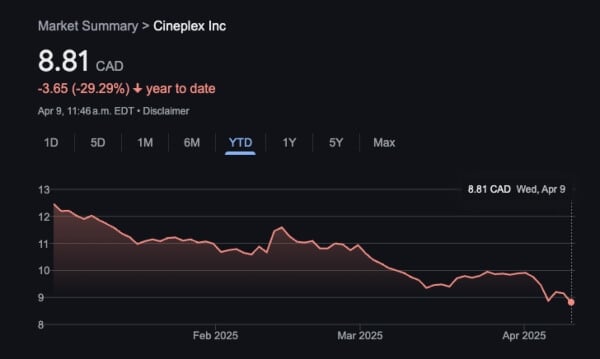
Cineplex Inc. says its box office revenue for March totalled $29.5 million, down from $59.2 million a year earlier when its results were powered by Dune: Part Two and Kung Fu Panda 4.
The movie theatre company says the results for March this year were led by Disney’s Snow White and Mickey 17.
For the first quarter of 2025 as a whole, Cineplex says its box office take totalled $101.9 million.
The result was down from $125.1 million in the first quarter of 2024.
Cineplex said the second quarter began with a strong debut by A Minecraft Movie.
It added that the quarter is also expected to see the release of Thunderbolts, Mission Impossible – The Final Reckoning, Karate Kid: Legends and the live-action adaptations of Lilo & Stitch and How to Train Your Dragon.
Roots has “limited” tariff exposure, watching for shift in consumer sentiment: CEO
Roots Corp (TSE: ROOT)
- Q4 total sales: $110.8 million, up from $108.2 million a year earlier.
- Quarterly loss: $21.7 million or 54 cents per share, compared to a profit of $14.6 million or 36 cents per share a year earlier.
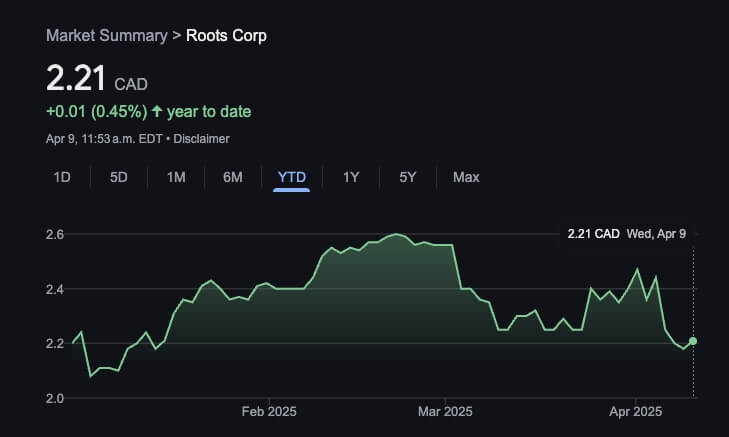
Roots Corp. says tariffs likely won’t have much of a direct effect on its business, but could weigh on consumer confidence.
Meghan Roach, chief executive of the Toronto-based apparel company, said the business has “limited exposure” to the tariffs U.S. President Donald Trump has levied on more than 180 countries.
“We have a relatively small business in the U.S. market and so we’re not seeing any significant impact on our business thus far,” she told analysts on a Wednesday call.
“From a consumer perspective, obviously we are looking to see what happens in Canada over the longer term.”
Roach’s remarks come as Trump’s tariff assault on the world has roiled stock markets, scuttled corporate expansion plans and pushed some companies to lay off staff as they try to keep their businesses alive.
Tap to continue reading
For the fashion industry, Trump’s tariffs stand to upend supply chains because they make it more expensive to move materials and inventory around the world.
Beyond the duties he hit Canada with, the U.S. imposed tariffs on countries like Bangladesh, China, India, Indonesia and Taiwan where many companies make garments and accessories because of their lower labour costs.
While the latest rounds of tariffs don’t impede goods moving between those countries and Canada, domestic brands that ship supplies and stock directly to their U.S. stores from those countries are affected.
According to its website, Roots only has two stores in the U.S. and produces leather goods like handbags, backpacks and jackets at a Toronto facility.
Some of its clothing is sourced from countries in Asia and Europe, but the company does not disclose how much comes from each region, Roach said in an email to The Canadian Press.
“Given that we ship all of our goods to Canada, these products are not impacted by the tariffs set out by the U.S. on other countries,” she wrote.
Its Canadian heritage also makes Roots more likely to benefit from the growing wave of shoppers supporting domestic businesses.
So far, Roach said the movement has boosted searches for products on the company’s website, but it’s hard to parse out how many of the company’s recent wins stem from the buy Canadian sentiment.
“What we saw was momentum in the Q4 period continuing into Q1, so it’s very difficult for us to tell specifically what any uplift might be from Buy Canada as opposed to our businesses continuing to trend well out of the fourth quarter,” Roach said on the analyst call.
Roots said Wednesday that its fourth-quarter total sales amounted to $110.8 million, up from $108.2 million in the same quarter last year.
Direct-to-consumer sales for the period ended Feb. 1 totalled $101.2 million, up from $97.8 million a year ago, while partner and other sales amounted to $9.6 million, down from $10.5 million.
Roach attributed some of the bumps to new marketing initiatives and artificial intelligence-based inventory management.
They and a $50-million impairment charge on intangible assets, which Roach said was a non-cash accounting adjustment, contributed to a quarter that saw Roots incur a loss of $21.7 million or 54 cents per share.
The result compared with a profit of $14.6 million or 36 cents per share a year earlier.
On an adjusted basis, Roots earned 40 cents per share in its latest quarter compared with an adjusted profit of 36 cents per share a year earlier.
Given that apparel businesses plan so far in advance, Roots also had confidence in how it will handle fall and winter.
The merchandise stocked at these times of year tends to include products it can push year-round, so inventory “won’t go bad at the end of the season,” Roach said.
Delta Air Lines had been expecting a record year—then a trade war broke out
Delta Air Lines Inc (NYSE: DAL)
(All figures in U.S. dollars.)
- Q1 earnings: $240 million or 37 cents per share, up from $37 million or 6 cents per share a year earlier.
- Operating revenue: $14.04 billion, up from $13.75 billion a year ealier.
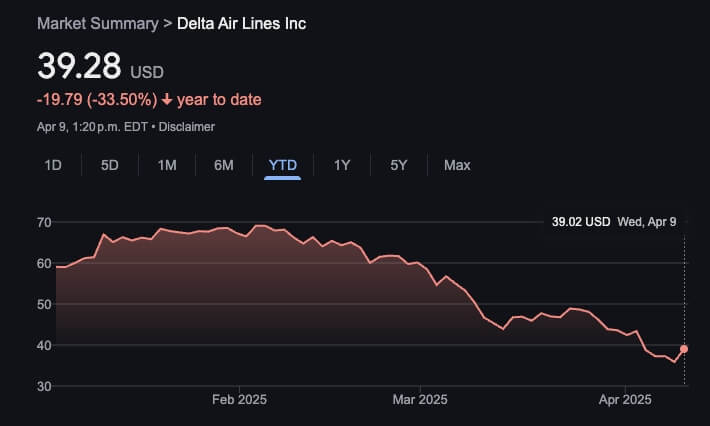
Delta Air Lines, which believed as recently as January that it was on track for its best financial year in company history, said Wednesday that disruptions in global trade have created such enormous uncertainty that it scratched its performance expectations for 2025.
It is a remarkable walk-back for the nation’s most profitable airline, and other companies are following suit. Hours after Delta remove its guidance for the year, Walmart dropped the first quarter operating profit guidance it had provided to investors, citing tariff risks.
Delta is cutting its flight schedule in anticipation of a slowdown in spending as businesses and households brace for higher prices.
“With broad economic uncertainty around global trade, growth has largely stalled,” CEO Ed Bastian said in a statement on Wednesday. “In this slower-growth environment, we are protecting margins and cash flow by focusing on what we can control. This includes reducing planned capacity growth in the second half of the year.”
In the first quarter, Delta earned $240 million, or 37 cents per share. A year earlier it earned $37 million, or 6 cents per share, when profit was weighed down by a new contract with pilots. (All figures in U.S. dollars.)
Tap to continue reading
Stripping out one time costs and benefits, earnings were 46 cents per share. That’s better than the 40 cents per share analysts polled by Zacks Investment Research predicted.
Shares of Delta Air Lines Inc. rose more than 8%. Citi analysts suggested Delta may be the best airline with which to ride out the uncertainty in coming months for investors who want to maintain exposure to the travel sector.
“Overall, these results show a carrier with a resilient business model, in light of significant uncertainties around demand and the global tariff controversy,” Stephen Trent of Citi Investment Research wrote in a note to clients.
Still, the sector has been battered this year as investors, anticipating trouble from rising tariffs, put their money elsewhere. Shares are down 41% this year for the nation’s most profitable airline, which is better than rivals American and United.
Quarterly operating revenue climbed to $14.04 billion from $13.75 billion, beating Wall Street’s estimate of $13.81 billion.
The average fuel price per gallon declined to $2.47 from $2.79.
Delta cut its first-quarter earnings and revenue outlook last month, saying at the time that a recent decline in consumer and corporate confidence amid growing uncertainty over the economy was weakening domestic demand.
Delta said in March that it expected first-quarter revenue to rise between 3% and 4% compared with a year earlier, down from projections of 7% and 9%.
In January, Delta released fourth-quarter results that topped Wall Street’s profit and revenue estimates, as the company benefited from strong demand during the crucial holiday period.
Yet conditions have deteriorated since then with a burgeoning trade war leaving consumers and businesses unsure about what comes next. Both have begun to pull back on spending, and that includes travel.
Bastian said Delta foresees June quarter profitability of $1.5 to $2 billion but will not update its full-year outlook “given the lack of economic clarity.”
The airline previously said that it expected 2025 earnings of more than $7.35 per share and free cash flow of more than $4 billion. At the time the company was expecting strong travel demand to continue, and that has clearly changed.
A month ago Bastian was confident enough to stick by Delta’s guidance for the year. Speaking at the JPMorgan Industrial Conference, the executive said at the time that Delta was feeling good about where it was at.
“There’s nothing that we’ve been through these last couple of months to indicate there’s any cracks in any of this,” he said. “We anticipate margins continuing to expand and we think margins will expand this year, even with the slower start to the year.”
Yet uncertainty over U.S. trade policy has rattled companies in every economic sector since then.
Bastian said during Delta’s earnings call on Wednesday that the airline is seeing softness in domestic consumer and business travel given all of the uncertainty. There’s been greater resilience in the international market so far, he added.
Bastian maintained that given current fuel prices and actions being taken, Delta is “well positioned to deliver solid profitability and meaningful cash flow in 2025.”
For the second quarter, the airline is looking for earnings between $1.70 and $2.30 per share, with total revenue down 2% to up 2%. Analysts surveyed by FactSet predict earnings of $2.21 per share.
“2025 is playing out differently than we expected at the start of the year,” Delta President Glen Hauenstein said. “As a result, we are adapting to current conditions while staying true to our long-term strategy.”
Tools
MoneySense’s ETF Screener Tool
Read more about investing:
- Best ETFs in Canada
- National Bank to buy Canadian Western Bank at $5 billion valuation
- Buying your first stocks in Canada
- How much is capital gains tax and other questions answered
The post Stock market news for investors: Cineplex, Roots and Delta report earnings appeared first on MoneySense.