
Stocks Slides After Bitcoin Tumbles On Hawkish BOJ Fears
After a torrid meltup last week to end the month of November on a euphoria, if extremely illiquid note, futures are once again sinking as we start the final month of the year, in a swoon that was again catalyzed by a plunge in bitcoin which appears to have been spooked by hawkish overnight comments by the BOJ which continues to bluster that it may hike rates one day… soon… for real this time. As of 8:00am S&P futures were 0.7% lower while Nasdaq 100 contracts were -1.0%. Bond yields are 1-4bp higher. Bitcoin slid below $86,000, dragging the entire space and pulling crypto-linked stocks into the red. The Magnificent Seven also declined in premarket trading, with Tesla, Meta and Nvidia each falling more than 1%. Global bond yields are all higher this morning: Japan yields are 3-7bp higher led by the 7yr amid hawkish hint from the BoJ. OPEC+ countries agreed to maintain group-wide oil output quotas (i.e., pausing oil output hike) for 2026 yesterday, given the YTD decline in oil; Oil +1.7% since last Friday’s close. Trump said on Sunday that he has decided on his pick for the next Federal Reserve chair after making clear he expects his nominee to deliver interest-rate cuts. The US economic calendar includes November final S&P Global US manufacturing PMI (9:45am) and November ISM manufacturing (10am).
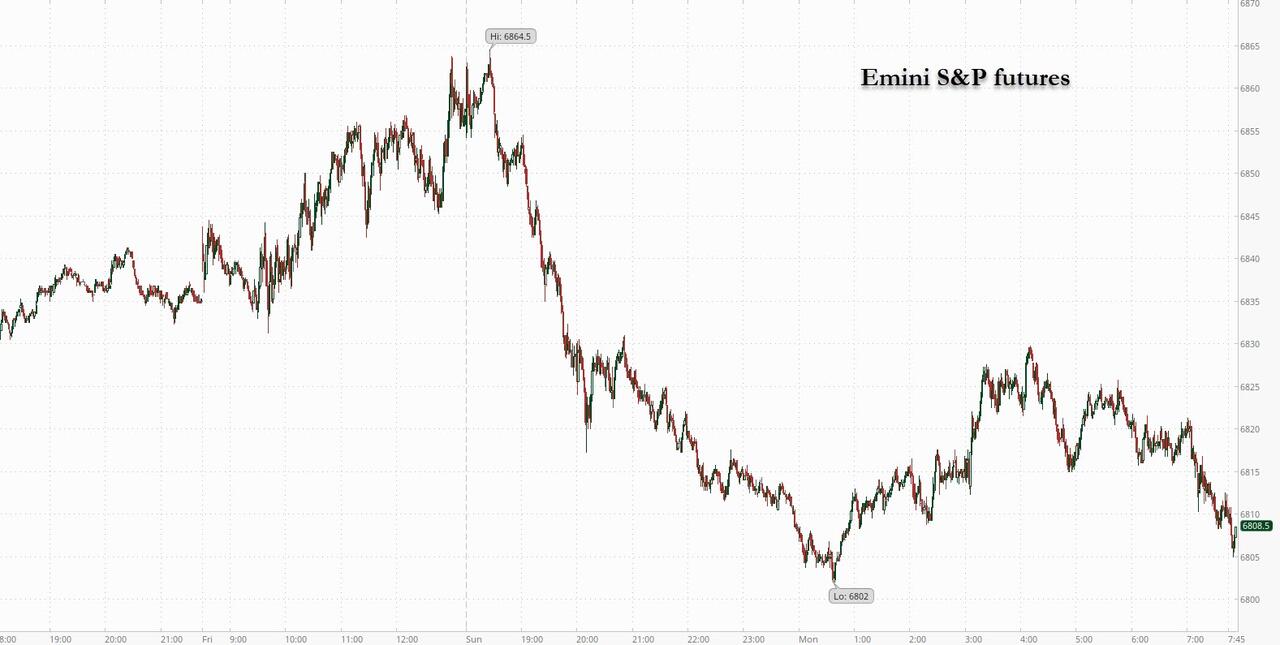
In premarket trading, Mag 7 stocks are all lower (Tesla -1.2%, Meta -1.4%, Nvidia -1.9%, Microsoft -0.6%, Amazon -0.4%, Alphabet -0.9%, Apple -0.6%).
- Crypto-exposed stocks slip following a drop in Bitcoin prices. Shares of Coinbase (COIN) are down 4%.
- Silver miners including Coeur Mining (CDE) rise as the precious metal extends Friday’s rally on tight supply. Coeur is up 3%.
- Vaccine makers are falling in early trading Monday as William Blair flags reports of a memo from a top FDA official,
- Vinay Prasad, that links Covid-19 vaccines in younger people to deaths associated with myocarditis. Shares of Moderna (MRNA) are down 4%.
- Barrick Mining (B) rises 4% after saying it is exploring an initial public offering of its North American gold assets as the Canadian mining company grapples with operational issues and cost blowouts.
- Canadian Solar (CSIQ) rallies 13% on news that the solar panel manufacturer is transferring the assets of its Chinese unit to Canadian ownership to safeguard sales into the US as Washington steps up scrutiny of imports from the Asian nation.
- Coupang (CPNG) falls 5% as the e-commerce firm faces an investigation by South Korean authorities over a data breach that affected about 33.7 million customer accounts.
- Leggett & Platt (LEG) shares are up 8% after Somnigroup International proposed an all-stock buyout.
Thanks to a powerful ramp on Friday, November marked the seventh straight month of gains for the S&P 500, the longest streak since 2021 as the monthly closed just barely in the green, rising 0.17%. It wasn't enough for the Nasdaq 100 however, which was hampered by concerns about stretched AI valuations, and fell 1.6% in the month.
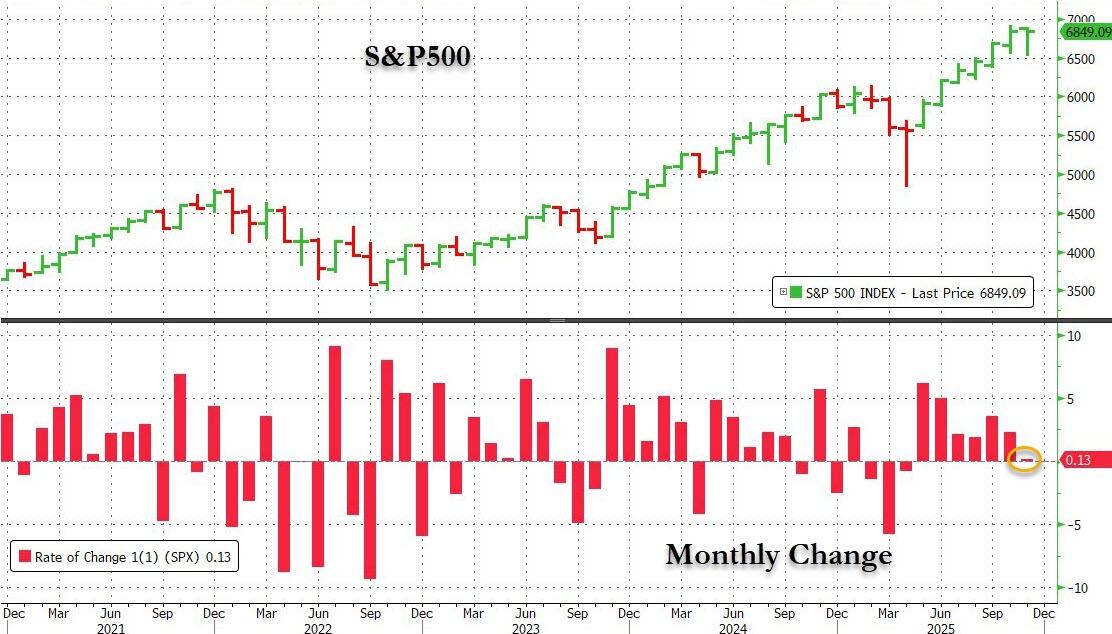
But so much for November, and December has seen a stark shift in sentiment with Monday's risk-off mood most evident in crypto, with Bitcoin tumbling below $86,000 before paring the drop.
Sentiment was hammered early after Japan’s two-year bond yield rose to its highest level since 2008 when Governor Kazuo Ueda offered his clearest hint yet that the BOJ may be nearing an interest-rate hike (of course he has been doing this for months and every time the market falls for it). Traders raised the odds of a BOJ rate hike in December to about 80% after Ueda told business leaders that the central bank “will consider the pros and cons of raising the policy interest rate and make decisions as appropriate.” Any hike would be an adjustment in the degree of easing, with the real interest rate still at a very low level, he said. The move weighed on global bonds, lifting the rate on 10-year US Treasuries by three basis points to 4.04%. The yen led gains among major currencies against the dollar.
“The market is still hesitating a bit ahead of the upcoming macro data, and before the Christmas rally people typically expect,” said Andrea Tueni, head of sales trading at Saxo Banque France. “The drop in Bitcoin is weighing on sentiment and so are the comments from the BOJ.”
Given Japan’s role as a major source of global liquidity, any shift toward policy normalization will have implications for carry trades.
“It’s a structural change in global markets that investors need to adapt to,” said Alexandre Baradez, chief market analyst at IG in Paris.
The month opened with traders focused on a slate of economic indicators due before the Federal Reserve’s next policy meeting, following the S&P 500’s seventh consecutive monthly advance in November. Meanwhile, gold continued its advance, and copper rose to a new record high on fears the global market is heading for a supply crunch. Attention is also turning to the central bank’s leadership, after President Trump said he has decided on a successor to Chair Jerome Powell.
This week’s data include ISM Manufacturing for November, due today, and a much-delayed inflation number for September, set to be released on Friday. A preliminary reading of consumer confidence in December is also due that day. That datapoint will be key given it’s a post-government shutdown reading on the health of the economy.
Markets are now signaling a December rate cut in December is nailed on. And Trump said Sunday he has made his mind up about who will be Fed’s next chairman. Trump’s chief economic adviser Kevin Hassett is seen as the likely choice, people familiar said last week. Hassett signaled markets were ready for the announcement of a new Fed chair. People familiar with the matter last week said that Hassett was seen as the likely choice to succeed Powell. Speaking on CBS’ Face the Nation on Sunday, he declined to address whether he considers himself the front-runner.
“December could prove more challenging than many expected, especially for those who thought last month’s 5% dip was the long-awaited correction,” said Ipek Ozkardeskaya, a senior analyst at Swissquote. “With Fed funds futures pricing nearly a 90% chance of a 25bp cut, there isn’t much room left for additional dovish fuel.”
It's not all gloom: traders are placing bullish bets on small-cap stocks in anticipation of lower rates. The Russell 2000 Index jumped 8.5% in the five trading days through Friday, making up the bulk of its gains this year.

In strategy, RBC’s Lori Calvasina said the S&P 500 should reach 7,750 over the next 12 months, based on sentiment, valuation, the economic outlook and monetary policy. Calvasina’s forecast, which implies a 14% rally for the benchmark, joins a chorus of strategists with bullish calls for 2026.
In Europe, the Stoxx 600 falls 0.4%, led by industrial, real estate and financial services. A drop for shares of Airbus also drags on the gauge after weekend news of a software glitch for its A320 jets. Industrial goods and services and real estate are the biggest fallers while the mining sector is rising as copper advanced to a record high. Here are some of the biggest movers on Monday:
- Airbus shares fall as much as 3.1% after the company had to attend to a solftware glitch.
- ASML shares rise as much as 3.1% after the company was added to JPMorgan’s Analyst Focus list and is its top pick in the wider semis sector, in which semiconductor capital equipment is viewed as the most attractive segment.
- European mining shares are among the best-performing sectors in the Stoxx 600 benchmark as copper advanced to a record high on the London Metal Exchange on fears the global market is heading for a supply crunch. Silver traded near a record.
- Reckitt Benckiser shares rise as much as 2.1%, the most in over a month, after Barclays upgraded the consumer goods company to overweight from equal-weight.
- European defense stocks fall after reports of progress in Ukraine-Russia talks over the weekend.
- Melrose Industries shares fall as much as 4.2% after news that CFO Matthew Gregory will retire from his position in 2026.
Earlier in the session, Asian stocks traded in a narrow range on December’s first trading day as investors braced for a data-heavy week, while gains in China helped offset regional weakness. The MSCI Asia Pacific Index was down 0.3% as of 4:50 p.m. Hong Kong time, led lower by tech shares, after earlier oscillating between gains and losses. Advances in Hong Kong and mainland China’s markets briefly lifted the region’s benchmark before losses in Japan, Taiwan and Australia pulled it lower. In Japan, Bank of Japan Governor Kazuo Ueda hinted that the central bank might lift interest rates at its next meeting this month, sending the Topix 1.2% lower. Meanwhile, market gains in China defied weaker-than-expected factory and manufacturing data, highlighting ongoing strains in the nation’s economic recovery.
In FX, the yen is leading gains against the greenback, rising 1% and taking USD/JPY below the 155-handle. The hint of a December interest-rate hike by Bank of Japan Governor Ueda played a role and also helped push Japanese 2-year yields to the highest since 2008. The yen is also likely benefiting from haven demand as broader risk sentiment struggles to recover after an abrupt turn lower during Asian trading hours.
In rates, treasuries fall, pushing US 10-year yields up 3 bps to 4.04%. European government bonds also decline.
In commodities, WTI crude futures rise 1.8% to near $59.60 a barrel as a key pipeline linking Kazakh fields to Russia’s Black Sea coast halted loading. Spot gold climbs $20 to $4257. Bitcoin also tumbled 6%, back below $86,000 after momentum ignition also sparked a rout and Korean momentum kamikazes joined in during Asian hours.
The US economic calendar includes November final S&P Global US manufacturing PMI (9:45am) and November ISM manufacturing (10am). While the Fed enters its pre-meeting blackout period, Powell and Governor Michelle Bowman are scheduled to speak, though they are barred from commenting on the economic outlook or policy. Fed officials will also receive a dated print of their preferred inflation gauge this week ahead of their final policy meeting of the year. Other data due include ADP private employment figures for November.
Market Snapshot
- S&P 500 mini -0.5%
- Nasdaq 100 mini -0.6%
- Russell 2000 mini -0.7%
- Stoxx Europe 600 -0.3%
- DAX -0.9%
- CAC 40 -0.4%
- 10-year Treasury yield +3 basis points at 4.04%
- VIX +1.6 points at 17.95
- Bloomberg Dollar Index -0.1% at 1216.62
- euro +0.2% at $1.1623
- WTI crude +1.8% at $59.62/barrel
Top Overnight News
- President Trump said Sunday he's decided who he'll nominate to be the next Federal Reserve chair, but he wouldn't be drawn on whether the pick is National Economic Council director Kevin Hassett. White House Economic Adviser Hassett said he will be happy to serve if US President Trump picks him as Fed chair.
- Trump said on Friday he is cancelling all executive orders signed by former President Biden using autopen and stated that any document signed by Biden with autopen, which was approximately 92% of them, is hereby terminated and of no further force or effect. Furthermore, Trump stated that Biden was not involved in the autopen process and if he says he was, he will be brought up on charges of perjury.
- US and Ukrainian negotiators said they held productive talks on a potential peace framework but have yet to reach a breakthrough. Steve Witkoff is due to meet Vladimir Putin in Russia tomorrow. BBG
- Black Friday sales climbed 4.1%, Mastercard said, surpassing last year’s growth, a sign US consumers are continuing to spend despite persistent economic concerns. But Adobe Analytics expects growth in Cyber Monday sales to ease from last year. BBG
- The State Department announced a pause on visa issuances for Afghan passport holders, and the US immigration service said it will halt all asylum decisions, while the US Citizenship and Immigration Services Director said USCIS halted all asylum decisions until they can ensure that every migrant is vetted and screened to the maximum degree.
- For years it has seemed no sticker price was too high for American car buyers. Even as average new car prices approached $50,000 this year, dealers fretted more over depleted inventories than losing customers to sticker shock. Those days may be ending as increasingly stretched consumers are starting to draw the line on what they will pay for a new car, according to dealers, analysts and industry data. WSJ
- Trump downplayed his social media post saying Venezuelan airspace should be considered closed. The president confirmed he recently held a phone call with his counterpart Nicolas Maduro, but declined to say how it went. BBG
- Swiss voters overwhelmingly rejected the proposal for a 50% inheritance tax for the super-rich: FT.
- A private gauge of China’s manufacturing sector showed Chinese factories cut back on activity in November, reflecting weaker growth momentum. China RatingDog manufacturing PMI for Nov came in below expectations at 49.9 (vs. the Street 50.5 and down from 50.6 in Oct). WSJ
- Micron will invest $9.6 billion to build a plant in western Japan to make memory chips for AI applications. Nikkei
- The BoJ will thoroughly discuss the possibility of an interest-rate increase at its coming meeting, Gov. Kazuo Ueda said, stoking hopes that it will resume monetary tightening this year. Now that Tokyo’s trade agreement with the Trump administration has reduced external risks, the BOJ governor said the central bank will pay special attention to the outlook for wage increases in Japan next year. WSJ
- Copper rallied to a new record on fears the global market is heading for a supply crunch. Silver extended gains. BBG
- South African President Ramaphosa dismissed US President Trump's threat to exclude the country from next year's G20 summit and reaffirmed South Africa's status as a founding member of the group: Reuters.
Macro
- China’s manufacturing activity contracted in November, according to official and private surveys, as stronger demand overseas after a trade truce with the US failed to reverse a deepening slowdown in the economy.
- Trump said Sunday that people shouldn’t read much into a social media post where he said Venezuelan airspace should be considered closed.
- Russian President Putin signed an order to allow visa-free entry into the country for Chinese citizens as ties between the two nations continue to deepen.
Trade/Tariffs
- China was reported on Friday to have banned imports of pigs, wild boars and related products from Spain's Barcelona province, according to a China Customs document. In relevant news, Mexico’s Agriculture Ministry also suspended pork product imports from Spain due to a swine fever outbreak.
A more detailed look at global markets courtesy of Newsquawk
APAC stocks began the new month mixed, with participants cautious as they digested the weak Chinese PMI data. ASX 200 was dragged lower by weakness in healthcare, telecoms, financials and tech, while sentiment was also not helped by disappointing Chinese PMI data and weaker-than-expected Australian Gross Company Profits and Business Inventories. Nikkei 225 slipped beneath the 50k level amid a firmer currency and risks of a BoJ rate hike in December, while there were hawkish-leaning comments from BoJ Governor Ueda, who said that they will consider the pros and cons of raising rates at the December meeting. Hang Seng and Shanghai Comp were kept afloat despite the discouraging Chinese PMI data, in which the headline official Manufacturing PMI continued to show a decline in factory activity at 49.2 (exp. 49.2) and Non-Manufacturing disappointed with a surprise contraction at 49.5 (exp. 50.0), while RatingDog Manufacturing PMI missed estimates at 49.9 (Exp. 50.5).
Top Asian News
- BoJ Governor Ueda is to deliver a speech at the Japan Business Federation on December 25th, according to the central bank.
- BoJ Governor Ueda said if their projection of economic activity and prices materialise, the BoJ will continue to raise the policy interest rate in accordance with improvements in economy and prices, while he added that even if the policy interest rate is raised, accommodative financial conditions will be maintained and the likelihood of their baseline scenario for economic activity and prices being realised is gradually increasing. Ueda also commented that at the December meeting, the BoJ will examine and discuss economic activity and prices at home and abroad, as well as market developments, based on various data, and consider the pros and cons of raising rates. Furthermore, he said it is important for FX to move stably reflecting fundamentals and that a weak yen works to push up consumer inflation, while they must be mindful that FX moves affect inflation expectations and underlying inflation in guiding policy.
- Japanese Finance Minister Katayama said it is “clear” that volatile swings in the FX market and the rapid weakening of the yen aren’t based on fundamentals.
- China’s financial regulator guides banks and insurers to fully provide financial support services related to the Hong Kong fire and said insurance institutions should promptly handle claims and other procedures for disaster-affected customers, while it added that banks should strengthen financial credit support and actively assist in disaster reconstruction.
- Indonesia said at least 303 people died in three provinces after severe rains caused floods and landslides.
- Vanke has reportedly requested 12-months to pay its bonds under the extension plan, Bloomberg reports.
European bourses (STOXX 600 -0.3%) are on the backfoot, following a cautious mood seen in APAC trade. The AEX (U/C) bucks the trend, with ASML (+1%) keeping the index afloat after positive analyst commentary. Euro