
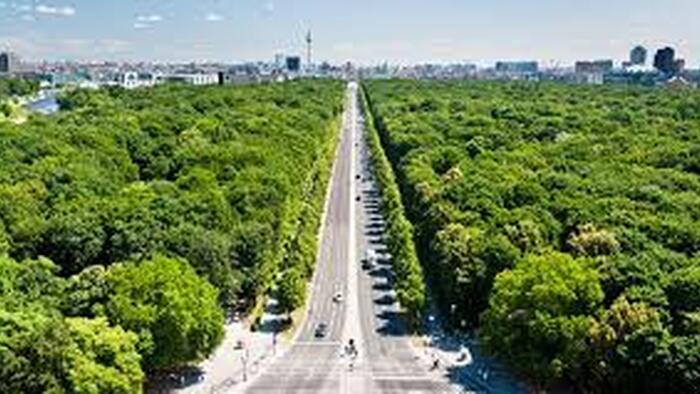
Berlin's 560,000-Tree Gamble: Climate Idealism Vs Economic Reality
Submitted by Thomas Kolbe
The Berlin Senate has passed the Climate Adaptation Act. It obliges the city to plant 560,000 trees by 2040. After Hamburg’s referendum on an earlier entry into climate neutrality, this marks the second plebiscitary victory for the climate movement.
Now, Berlin’s drivers are in the crosshairs. Beyond rising car taxes and CO₂ fees, two popular initiatives in particular are about to make life difficult for daily commuters.
Referendum Turned into Law
Alongside the citizens’ initiative Volksentscheid Berlin Autofrei, which aims to enforce a largely car-free city center within the Berlin S-Bahn ring, a second movement has now successfully inserted itself into the legislative process for the first time: the BaumEntscheid initiative.
On November 3, the Berlin House of Representatives approved the now legally codified BaumEntscheid initiative as part of the Climate Adaptation Act by a wide majority. Only the AfD voted against the law.
The original “Tree” referendum had been rejected for cost reasons, estimated at roughly twice the price of the now-adopted citizens’ initiative.
The new law requires the Berlin Senate to provide one million healthy urban trees across the city by 2040. Given the current stock of 440,000 trees, this means an additional 560,000 trees must be planted.
Known under the code name “TreesPlus Act,” the Climate Adaptation Act stipulates that in public streets, especially on each sidewalk and on sufficiently wide medians, a healthy, maintained, or developing tree should be planted every 15 meters on average. This applies particularly in densely built areas deemed “heat-prone” by policymakers.
The goal is to compensate for the loss of street trees in recent years and, in the first phase, to plant around 10,000 new street trees by the end of 2027.
Berlin politics envisions broad citizen participation. Guided by professional horticultural expertise, neighborhoods are to help plant trees. Companies are also encouraged to participate in the effort.
Berlin Idyll. Pure Friedrichshain vibes, unbounded climate activism, detached from the reality of the rest of the country.
Idyll for Some, Nightmare for Others
What sounds idyllic in Berlin’s green bubble is likely to mean one thing in practice: fewer parking spaces, fewer lanes—and more pressure on everyone who commutes by car every day.
But that’s not all. Alongside the massive reforestation initiative, the Senate is compelled to designate 170 so-called “heat districts” within a year—areas where local temperatures are to be lowered by at least two degrees through de-densification and de-paving measures. These are densely built areas with high traffic and extensive sealing, now facing major redesigns under the Climate Adaptation Act.
Specifically: parking strips and side areas are to be unsealed and greened, parking spaces converted into bike lanes, and new public transport spaces created. The law refers to a so-called environmental network—a priority system for pedestrians, cyclists, and public transport that will take precedence over individual car mobility.
Additionally, 1,000 so-called cooling islands are to be created, providing citizens safe retreats from heatwaves. These include small parks or air-conditioned entry areas in designated buildings that open as needed.
Berlin is fully indulging its climate paranoia.
Triumph of the Climate Movement
That the referendum has now become law is seen as a major triumph for the climate movement. As often happens, Berlin could become a model for other German metropolises, with Hamburg a likely candidate for further experiments.
The timing of this climate policy step is remarkable: while key political actors—primarily the U.S. government—are increasingly stepping back from strict climate policies due to the economic damage of high energy prices and deindustrialization, Berlin is taking the opposite course.
The capital—highly subsidized, often criticized as an eco-socialist biotope among Europe’s cities—is intensifying its fight against individual mobility. Trees versus parking spaces—the battle against the automobile is now official policy.
Fiscal Detachment
How detached Berlin politics and the politically active citizenry are from economic reality and fiscal prudence is evident in the state budget. This year, the city is expected to receive around €4 billion from the federal financial equalization system. Yet the net deficit remains over €3 billion.
Realistically, there are no funds for this initiative, and whether Berlin can freely draw from federal special funds is uncertain. The city is currently at the mercy of climate NGOs and their political enforcers in the House of Representatives.
Berlin is clearly pursuing political utopianism in two ways: first, at the expense of other states practicing stricter fiscal policies and forced to transfer funds to the notoriously cash-strapped Berlin; second, in an economic reality completely detached from the needs of the urban economy and trade. A policy targeting commuters, tradespeople, and anyone reliant on individual mobility.
Economy Overlooked
In Berlin, the interests of business seem to play almost no role. Almost unanimously, only the quasi-religious climate movement is honored, in hopes of political gains. It is a struggle of left-radical, eco-socialist, and socialist forces, with even the Union now occupying the midfield.
Berlin, the capital of Antifa, green radical environmentalism, and a peculiar form of political escapism, ventures onto thin ice with its Climate Adaptation Act. It may not yet be widely recognized that the surrounding areas are in severe economic crisis—a state apparently assumed as natural in the capital.
Yet this detachment means that utopian experiments, such as the deliberate assault on individual mobility under the guise of urban greening, could quickly run aground on the cliffs of state debt, catching many by surprise.
* * *
About the author: Thomas Kolbe, born in 1978 in Neuss/ Germany, is a graduate economist. For over 25 years, he has worked as a journalist and media producer for clients from various industries and business associations. As a publicist, he focuses on economic processes and observes geopolitical events from the perspective of the capital markets. His publications follow a philosophy that focuses on the individual and their right to self-determination.
Tyler Durden
Sat, 11/08/2025 – 07:00