
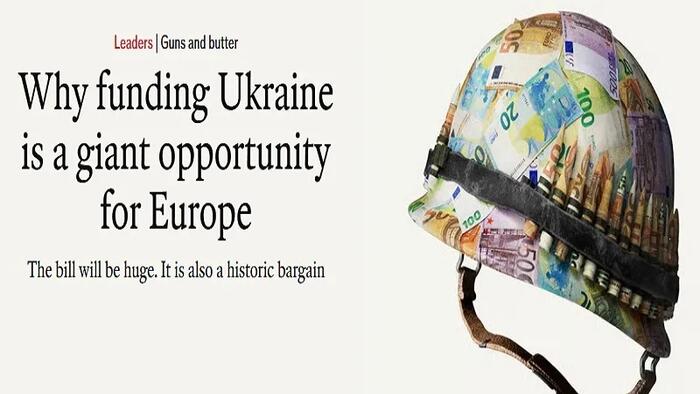
What's The Real Reason Why The Economist Wants Europe To Spend $400 Billion More On Ukraine?
Authored by Andrew Korybko via Substack,
Federalizing the EU, not the political fantasy of defeating Russia, is the real goal, which requires another four years of proxy warfare and at least another $400 billion to complete.
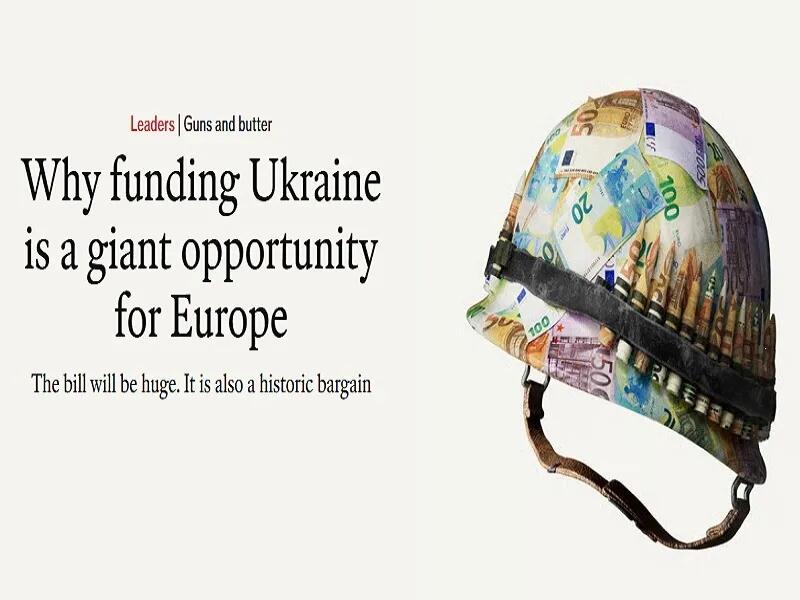
The Economist argued that the EU and the UK should meet Ukraine’s estimated $390 billion financing needs over the next four years.
In their words, “Another half-decade of [Russia’s supposedly worsening economic-financial situation] would probably trigger an economic and banking crisis in Russia”, while “Any long-term financing solution for Ukraine would help Europe build the financial and industrial muscle it needs to defend itself.”
This would only cost 0.4% of GDP per NATO member (excluding the US).
They also fearmongered that “The alternative would be for Ukraine to lose the war and become an embittered, semi-failed state whose army and defence industries could by exploited by Mr Putin as part of a new, reinvigorated Russian threat.” While it’s unlikely that Ukraine would ever team up with Russia to threaten any NATO state, Ukraine might blame Poland for its loss, after which Ukraine might back a terrorist-separatist campaign in Poland waged by its ultra-nationalist diaspora as warned about here.
Regardless of whatever one might think about the aforesaid scenario, the point is that The Economist is employing a typical carrot-and-stick approach in a bid to persuade its elite European audience that it’s less costly for them to foot Ukraine’s estimated $390 billion bill across the next four years than not to. The immediate context concerns the US’ intensified proxy war of attrition against Russia as part of Trump’s new three-phased strategy that’s meant to bankrupt the Kremlin and then stir unrest at home.
To be clear, citing this strategy doesn’t imply endorsement, it’s just meant to show why The Economist thinks that its audience might now be receptive to its appeal. About that, it’ll be a hard sell to convince folks that they need to subsidize Ukraine to such an extent over the next nearly half-decade, which could entail more taxes and social spending cuts. After all, the $100-110 billion spent this year (“the highest sum yet”) didn’t push Russia back, so the same amount over the next four likely won’t either.
Russia’s war chest is also big enough to continue funding the conflict during this time, so The Economist’s proposal would merely retain the status quo instead of alter it in the West’s favor. The dynamics might even shift further in Russia’s favor, The Economist candidly warned to its credit, “if Russia can tap China for funds”. In that scenario, the EU would likely be compelled to “tap” its own population for an equivalent sum to at least retain the status quo, thus worsening their burden with no clear end in sight.
As The Economist wrote: “for the EU to issue bonds collectively would create a bigger pool of common debt, deepening Europe’s single capital market and boosting the role of the euro as a reserve currency. A multi-year horizon for weapons procurement would help Europe sequence the build-up of its defence industry.” This aligns with July 2024’s assessment that “The EU’s Planned Transformation Into A Military Union Is A Federalist Power Play”. Federalizing the EU, not defeating Russia, is therefore the real goal.
This insight enables one to understand why EU elites – especially in EU-leader Germany – complied with the US’ anti-Russian sanctions at their own economic expense. In exchange for neutralizing the euro’s potential to rival the dollar, EU elites were allowed to accelerate the bloc’s federalization to entrench their power, which the US approved after no longer viewing the now-subordinated EU as a latent threat. Another four years of proxy warfare and at least ~$400 billion are now required to complete this process.
Tyler Durden
Thu, 11/06/2025 – 06:30