
How Progressives Broke The Constitution And Praised Themselves For It
Authored by Wanjiru Njoya via The Mises Institute,
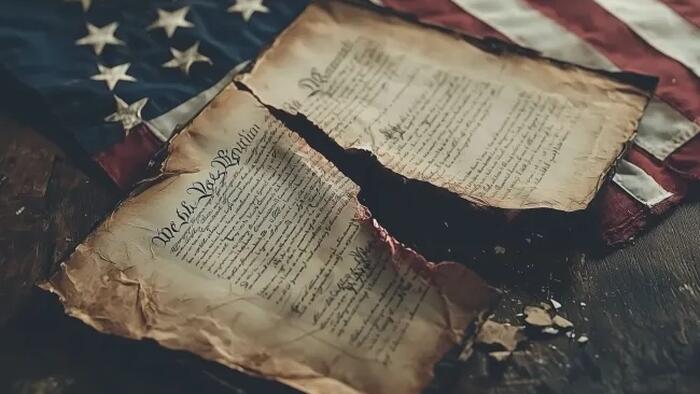
In his article “Is the Constitution Broken beyond Repair?” David Gordon draws attention to a phenomenon that is often overlooked, namely, the great rejoicing among some constitutional lawyers over the fact that “to establish the new Constitution, Lincoln overthrew the first one… he replaced the old, immoral Constitution with a new one based on equality.” This is indeed one reason why some of Lincoln’s admirers still celebrate the burning of the South by the Union Army—the devastation and destruction of the South symbolizes for them the brave new world of equality and social justice forged by a righteous army through fire and steel.

Most people, if they understood what was really being celebrated here, would be bewildered. Although Abraham Lincoln and the Union Generals Ulysses Grant and William Sherman are generally admired for saving the Union by those who do not consider the consent of states to be necessary, they may not necessarily think the war was commendable in itself or worthy of celebration; they merely consider that war was necessary for Lincoln to advance his righteous cause. They would view the claim that Lincoln rejected the constraints set by the Constitution as some sort of critique, at the very least—while we can and do debate matters of constitutional interpretation, surely we all accept the premise that a president should not actually overthrow the Constitution? Shouldn’t any president at least try to pretend to uphold the Constitution, even as he brazenly drives a coach and horses through it? Even if he is an unashamed hypocrite who believes double standards always apply to his conduct, he should at least make a show of believing that he sees his actions as constitutional, and should by no means concede to complaints that he is subverting the law.
But, rather surprisingly, some Lincolnite constitutionalists do not see matters that way. They believe that deliberately subverting the Constitution is actually very good if it is done with good intentions—namely, intentions of which progressives approve. As they see it, the new Constitution created by Lincoln’s war is more egalitarian and just than the old one written by slave owners. They believe the overthrow of the old Constitution ought to be welcomed by everyone who upholds “the idea of America”—the “idea” being, of course, progressivism. Nor is this desire to destroy the Constitution new. In the 19th century, the abolitionist William Lloyd Garrison described the Constitution as an “agreement with hell”:
Garrison then produced a copy of the 1850 Fugitive Slave Law and put a match to it. Amid cries of “Amen” the hated document burned to a cinder… As Martin Luther had burned copies of canon law and the papal bull excommunicating him from the Catholic Church for heresy, Garrison consigned each to the flames. Holding up a copy of the U.S. Constitution, he branded it as “the source and parent of all the other atrocities–‘a covenant with death, and an agreement with hell.’” As the nation’s founding document burned to ashes, he cried out: “So perish all compromises with tyranny!”
The abolition of slavery in 1865 only fanned the flames of this revolutionary fever. The new rallying cry was that steps must be taken to ensure that slavery “by a different name” would never return, and Reconstruction amendments were accordingly forced through. Tennessee, which was the only state in the South to “willingly” ratify the Fourteenth Amendment, only did so after threats of force.
In Tennessee, opponents of the Amendment absented themselves from the House in order to prevent a quorum. This did not stop the supporters of the Amendment, who forcibly seized two absent members and held them in a committee room. The House ignored a court order to release the two and overruled the Speaker, who ruled there was no quorum present.
To many people this might seem, at the very least, mildly embarrassing but nevertheless understandable in the tumultuous aftermath of war. There is a process for amending the Constitution, and the use of force is not part of that process, so at the very least these irregularities ought to be condemned. But for progressives, overthrowing the old Constitution by any means necessary is praiseworthy, because the Fourteenth Amendment brought equality and justice! Let justice be done by any means necessary! In his foreword to Raoul Berger’s Government by Judiciary: The Transformation of the Fourteenth Amendment, Forrest McDonald observes that activist courts enthusiastically endorsed the Reconstruction amendments without any qualms. He explains that “advocates of judicial activism began to assert that neither the words of the Constitution nor the intentions of the framers are any longer relevant.” After all, the framers were “racist” so nobody should care what their original intentions were.
After 1865, the progressive amendment of the Constitution continued inexorably under the civil rights regime. When Christopher Caldwell wrote his critique of the Civil Rights Act usurping the Constitution, one reviewer summarized Caldwell’s analysis under the title “The Law that Ate the Constitution.” Now, many readers would assume that “the law that ate the Constitution” is a provocative title denoting an unwelcome development, and that the whole point of Caldwell’s analysis would surely have been to warn us that the Constitution was under threat. Even those committed to “the idea” of civil rights, who may never be persuaded that civil rights pose a threat to the constitution—the judges just need to be a bit more careful to avoid subverting the Constitution, right?—might nevertheless appreciate Caldwell’s attempt to warn us of a potential threat to which we may wish to be alert. But, astonishingly, some law professors view it not as a threat but as cause for celebration—if Caldwell is right that the civil rights law is now the de facto Constitution and has displaced the racist de jure Constitution, they would take that not as a warning but as a wonderful outcome that merits celebration.
Progressives favor the centralization of constitutional authority in the federal courts, and therefore, as they see it, if the courts indeed willfully distorted constitutional history to achieve that goal, so be it. After all, judges are distorting the Constitution for a good cause—in the service of equality, fairness, and justice. Raoul Berger, writing about the role of the Fourteenth Amendment as a platform for the “continuing revision of the Constitution under the guise of interpretation,” notes how the progressive Warren Supreme Court was hailed as “keeper of the national conscience.” Therefore, when conservatives like Thomas Sowell warned about “the quiet repeal of the American Revolution,” progressives saw that not as cause for alarm but as evidence that they are winning. As they see it, activist courts are to be commended for deliberately replacing the American Revolution with a racially-enlightened social revolution. Far from denying that they have subverted the Constitution, they are supremely proud of themselves for having done so.
They have convinced themselves that the new de facto Constitution better reflects “American values.”
The point here is not simply that there are different schools of statutory interpretation, by reference to which some constitutionalists uphold a “purposive” or “living tree” approach which tries to give meaning to what they see as the underlying goals and values of the Constitution.
Most progressives who champion purposive interpretation do not claim that the old de jure Constitution should be altogether destroyed and replaced with a de facto new Constitution that is morally superior—most would at least attempt to offer some sort of argument that their inventions are a matter of reinterpretation and redefinition of the words actually written in the original Constitution.
The progressives who praise themselves for displacing the Constitution altogether make a very different argument.
They do not claim to be engaged in creative reinterpretation, but to be abolishing the de jure Constitution altogether in order to replace it with a more worthy compact rooted in their civil rights revolution.
Tyler Durden
Wed, 10/22/2025 – 19:15