

When you sell your shares of stocks/ETFs/mutual funds in a taxable brokerage account, your broker will also record the specific shares and the original value at purchase (cost basis) at which you bought them. Even if you don’t expect to sell your shares very often, it can still be important how you set the cost basis tracking option inside your brokerage account.
Allan Roth has a useful ETF.com article about why your choice of cost basis tracking could possibly make a difference of thousands of dollars or more. Here’s his real-world example:
Not too long ago, a very seasoned and knowledgeable investor shared a story of a mistake he recently made. He meant to buy 300 shares of the Vanguard Total Stock Market ETF (VTI) but mistakenly punched an extra zero and bought 3,000 instead.
He quickly realized his mistake and sold the 2,700 shares he accidentally bought. The ETF was only up slightly, and he used the Minimum Tax (MinTax) cost basis method on Vanguard’s brokerage platform. He was shocked to learn he just realized a long-term capital gain of about $150,000. […] Because the recently purchased lot of VTI had a tiny short-term gain, it was last in the prioritization of sales and his prior lots with large long-term gains were sold.
Are your current settings still the default? For example, at Vanguard, the default cost basis method appears to be:
- Average cost (AvgCost) as the default cost basis method for mutual funds at Vanguard.
- First-in, first-out (FIFO) as the default cost basis method for all investments other than mutual funds.
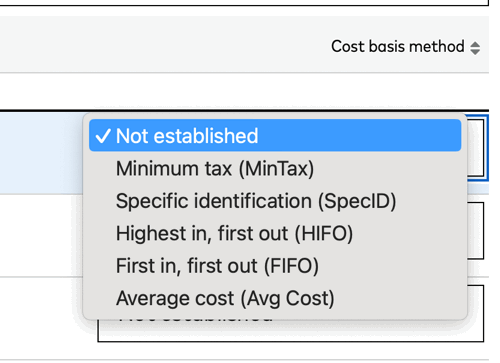
You can usually change this setting. Here’s what I see as my available options at Vanguard:
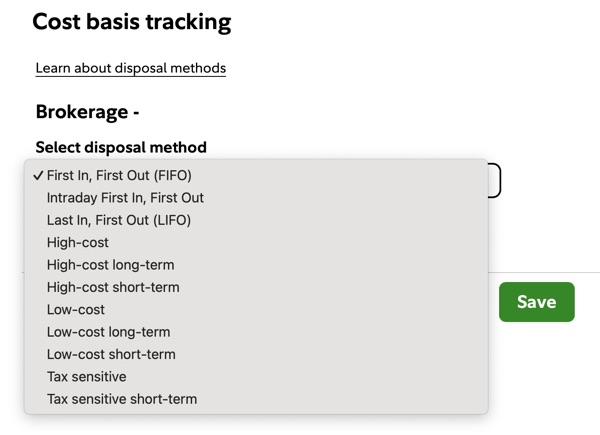
At Fidelity, the default cost basis method appears to be First-in, first-out (FIFO) as well for brokerage accounts. Here’s what I see as my available options at Fidelity:
Roth suggests that the best practice is to manually choose specific tax lots. In my experience, using the SpecID setting at Vanguard will force you to choose the “specific shares” that you want to sell when you enter the order. This has come in handy for me, forcing me to think about the tax consequences before I submit. Roth also shares a recent change that Vanguard only allows market orders (no limit orders) on SpecID sales. He decides that it is more important to get the tax basis right than the small added safety of a limit order. I would agree.
At Fidelity, when you sell the shares, on the order ticket there is either a “Sell Specific” action option, or after “Sell” you can click on a small link to “Specify shares”. Unfortunately, I don’t see an option that forces you to manually pick a specific tax lot. Fidelity does a good job of presenting the tax lots clearly on your Positions screen, but you’ll still have to remember on your own when the time comes.
However, if you do forget but remember quickly afterward, I found these instructions to reassign the tax lots before settlement:
Follow these steps to specify tax lots AFTER a trade is placed but before settlement:
– Log into Fidelity.com and Select “Accounts & Trade,” then choose “Account Positions”
– Navigate to the “Closed Positions” link above the “Symbol” column
– Click on “Select Action” next to the appropriate account and choose “Reassign Lots”
Most major brokerage firms should have a similar option, although some of the new ones may not. For example, Robinhood only added their Tax Lots feature in December 2024, more than a decade after starting out. Yet even they admit the potential benefits:
Tax Lots allow customers to choose specific assets to sell—whether it’s the ones held long term, the ones with the lowest or highest cost basis, or the ones that might have experienced the greatest loss. This gives customers the ability to make more informed decisions and manage their tax bill.
In any case, I used this as a timely reminder to be double-check all of your current brokerage account settings.